1. Introduction
In recent years, museums and galleries have become key sites of access to the history and diversity of performance art, and to its actualization.
In the period 2005 to 2020, during which we[1] inquired into the relationship between performance art and presentation formats in the museum context as part of the research project Archivprozesse der Aufführungskünste (Archival Processes and the Performing Arts), activity in the field increased, in terms of both discourse on performance in the museum and the related curatorial practices.
A steadily rising number of exhibitions and reenactments can be seen to actualize and re-vision the history of performance art or integrate performances into an exhibition context.[2] They reflect the current tendency to institutionalize performance art and the growing interest in not only revisiting past art events but also commercially exploiting them on the art market.[3] At the same time, these present-day stagings and contemporary contextualizations reveal new forms of appropriation: fluid approaches to dealing with archives and collections on the history of performance. They inquire anew into the character of the artefacts, relating them to current as well as established narratives about the (hi)stories of performance and exploring their readability in ever new contexts.
Such events can also be seen as comments in the debate concerning the ontological status of performance art—as primarily initiated by Peggy Phelan.[4] The statement "Performance’s only life is in the present," with which Phelan opens her well-known book Unmarked. The Politics of Performance, has often been interpreted as a warning against the irrevocable loss of performance authenticity. The curatorial practice behind exhibitions that integrate the performative negates—often in an explicitly reflective manner—this idea of irrevocable loss and instead practices preservation by means of transformation.
Exhibitions—like performances—provide temporary, especially arranged access to the history and actualization of performance. They are the outcome of curatorial actions which take place in various cultural and contemporary-historical constellations and can, in turn, be seen as unique constellations.
In the following I would like to expand on these observations by describing some discursive perspectives on exhibiting and performing that have emerged in recent years and examining in greater depth an example of performance art/exhibition constellations. At an intermediate stage, I will elucidate the term constellation in a curatorial context.
2. Performance art in the museum since the 2000s – discursive contexts
Presentations of performance art and its history in the museum have not only launched a debate about whether performance art is an independent art-historical genre. They have, in fact, produced this independence. In this way, they demonstrate the significance—the importance and relevance—of performance art in the art-historical canon.
By presenting a selection of works and artists and showing artefacts in a specific way, exhibitions establish a canon on the history of performance art. The term canon is understood here as a collection of works chosen—in this case by curators, in others by art and theatre historians—from the plethora of individual works and artistic approaches making up past performances, because they are deemed significant and suitable for being passed on and actualized. The term canon can therefore also be defined as the knowledge of the history of performance—outside of scholarly research—that is accessible.
Even most exhibitions with a historical focus encompass more than the presentation of documents or objects marking the remains of past events—which they often show in the form of installations, re-staged as new artistic works.[5] Indeed, they embed their presentations of the history of performance art in constellations of various formats, such as live performances, discursive events and film screenings. In general, such constellations—like the practice of re-enactment discussed below—are characterized by what has been described and discussed as the overlapping and enfolding of different temporalities.[6]
3. Exhibition and reenactment: syncopated time
Reenactments are a specific type of performative presentation in the museum context that combine examinations of history with actualizing appropriations. A prominent example of recent years was the series Seven Easy Pieces by Marina Abramović, shown over seven evenings in 2005 in New York’s Guggenheim Museum. Taking up the basic constellations of the historical actions to which she referred, Abramović appropriated and overwrote works by Bruce Naumann, Vito Acconci, VALIE EXPORT, Gina Pane and Joseph Beuys, showing each of them as a seven-hour-long "durational performance."[7]
As early as the 1990s, Claire Bishop noted a heightened interest in re-enactments in the art field as a way of "revisiting previous works and historical events in order to explore difference through repetition," which inspired curators to integrate them into exhibition concepts.[8] One of the most prominent examples in this case was the "re-doing" of Allan Kaprow’s 18 Happenings in Six Parts for the retrospective exhibition Allan Kaprow – Art as Life (2006-2008).[9] In the context of museum presentations and performance art collections, "re-enactments, and re-interpretations” are also considered as “strategies for the preservation of performance and new media art."[10]
By combining a performance in the here-and-now with references to a performance that has already become history, re-enactments and other forms of performative re-iteration uniquely bring the event character of various intertwining temporalities into focus.[11] Rebecca Schneider reflects on this convergence of different temporalities in her book Performing Remains, writing:
I am curious to ask here about a more porous approach to time and to art – time as full of holes and gaps and art as capable of falling and crossing in and out of the spaces between live iterations. . . . This book explores the warp and draw of one time in another time—the theatricality of time—or what Gertrude Stein. . . . referred to as the nervousness of “syncopated time”.[12]
Here, Schneider compares re-enactment practices in the field of art with their equivalent in what is known as Living History, which is often concerned with re-staging war scenes. A number of exhibitions mounted in the 2000s also made this connection, such as Life, Once More (curated by Sven Lüttiken, Witte de With, Rotterdam 2005) and History will Repeat Itself (curated by Inke Arns, Gabriele Horn, Hartware MKV Dortmund + KW Institute for Contemporary Art Berlin, 2007/08). Considering the reenactment phenomenon in a broader perspective, they conceived the artistic appropriations partly as critical examinations of the popular practices of Living History.[13]
4. Performance as movement in, with and for the museum
"So, it is particularly striking that as we near the third decade of the 21st century, the prevalence of performance in museums predominantly takes the form of contemporary dance."[14] This observation summarizes the recent tendency towards preserving performance and resonates with numerous similar voices who have noted a shift in focus since 2013/14 on to dance in the museum. In 2015 Bojana Cvejic and Ana Vujanovic found that: "The currency that performance had in the 1990s seems now to be replaced by choreography."[15]
Changes in curatorial policy within the high-profile, internationally renowned institutions (MoMA, Tate Modern, Guggenheim) are not the only evidence of this tendency. Claire Bishop, meanwhile, has shown that the connection between dance and the museum has a long history in the above-named institutions, in some cases going back to the 1940s.[16]
The increasing number of experiments with the “choreographic” within the museum in the past decade, the staging of the live body as a work of art, prompt not only the reconsideration of the museum's object-centric infrastructure in a practical sense, but a more nuanced consideration of how subject-object boundaries are defined—and elaborated—within this context.[17]
Here, Catherine Wood, then curator for contemporary art/performance at the Tate Modern in London, reflects on the shifts in the museum dispositive that have been induced or made necessary by the rise in performative formats. She uses the term "choreographic" partly in view of the developments mentioned in the previous section and partly because it allows her to discuss movement in the museum context on various interrelating levels: the movements performed by the human bodies/actors on show; the agency of the exhibited objects, in reference to Bruno Latour;[18] and the (staged and elicited) movement of the spectators. The advent of the performative in the museum context has caused this constellation to change. Bruno Latour’s actor-network theory and the "material turn"[19] is cited to underpin the notion that objects should not necessarily be perceived as completed entities. On the other hand, museum presentations can bring the object aspect of performances and actions to the fore.
Georgina Guy takes up these considerations and finds even broader shifts in her work Theatre, Exhibitions, and Curation. Displayed & Performed. Analysing curatorial and artistic practices and projects in a range of presentation formats from "displayed" to "performed", she observes a variety of constellations of objects with agency, dramatized displays and bodies displayed as objects.
By investigating a new context of visual arts exhibition which draws on ideas and tropes of the theatrical event, it is my intention to profile how one mode performs in relation to the conventional ontologies of another and to propose a symbiotic relationship between theatricality and display.[20]
By marking out "displayed" and "performed" as two distinct modes of institutional presentation, Guy also draws attention to their different dynamics – an aspect which plays a role in considerations on more general changes in exhibiting (and curating), and takes up the idea that exhibiting is also a form of putting-on-stage.[21]
What Guy and other authors see as a broadening of and positive shift in the museum system is elsewhere criticized as carrying the risk of sensationalizing performance art and reducing it to a form of public amusement.[22]
5. Intermezzo – Curating in constellations
Museums and galleries have become key sites of access to the history of performance art and its actualization. Any analysis of these developments must take account of the rising importance of curating/the curatorial. Curators, including those of the exhibitions we analysed, place thematic stresses, inquire and research, select and present, make connections, mediate, and focus attention.
They provide access to the knowledge constellations they visualize and realize, each of which operates in a specific historical and cultural context. Exhibitions and their accompanying programmes and publications are materializations of these knowledge constellations.
Today, the constellation concept plays a major part in the field of curatorial studies—or in reflections on the curatorial as a method that overarches the art field in the narrow sense. An early milestone was Paul O’Neill’s 2012-published essay titled "The curatorial constellation," pointing out that exhibitions and curating are primarily concerned with making connections.[23]
Beatrice von Bismarck has elucidated the term—in the light of both its origins in the fields of astronomy and astrology and its significance in the philosophy of Theodor W. Adorno and Walter Benjamin—in a recent publication.[24] And she has applied it productively to the practice of curating, writing:
The term constellation defines the interaction of human and non-human participants in a curatorial situation, all of whom enter from their previous contexts into a new one and undergo changes in this transformed relationality. Archivists, artists, curators, researchers, the various archived materials in their respective mediality, the discourses associated with them, and the institutions enter into new relationships with each other and are equally endowed with agency as players in the situation. The fabric of relations as a constellation is temporary, changeable, and performative.[25]
It is important, then, to understand curating as an activity that forms relationships on various levels: between human and non-human actors, between spaces and objects or events, between art venues and their cultural and social environments, between players of different roles (curators, mediators, spectators), and between different temporalities. Crucially, these are dynamic and changeable.[26] In this light, constellations are conceived as the result of conceptual decisions which denote, visualize and communicate a specific interpretation of history and a particular—albeit temporarily valid—canon.
Below, I will use the term constellation in this sense to refer not only to individual exhibitions but also to the relationships into which different—roughly concurrent—exhibitions in one place or region can be seen to enter. In this way, I intend to take on what Felix Vogel has found to be a gap in research in the field of exhibition histories:
[…] there is a notable tendency to present exhibitions as singularities […] and it does not mean that there is no analysis of the local, political or social contexts of exhibitions. By “singularity” I mean that there is very little analysis of exhibitions in connection with other exhibitions, although such synchronic comparison would make sense for several reasons.[27]
In 2011, the magazine Afterall launched inquiries leading to a series of publications titled Exhibition Histories, intending to supplement art-historical research by documenting and contextualizing "landmark" exhibitions. As their research progressed, it became necessary for them to shift the project’s parameters: by extending and modifying the canon of famous exhibitions, by altering the basic conception of what an exhibition can be, and by involving a broader variety of experts (polyvocality).[28]
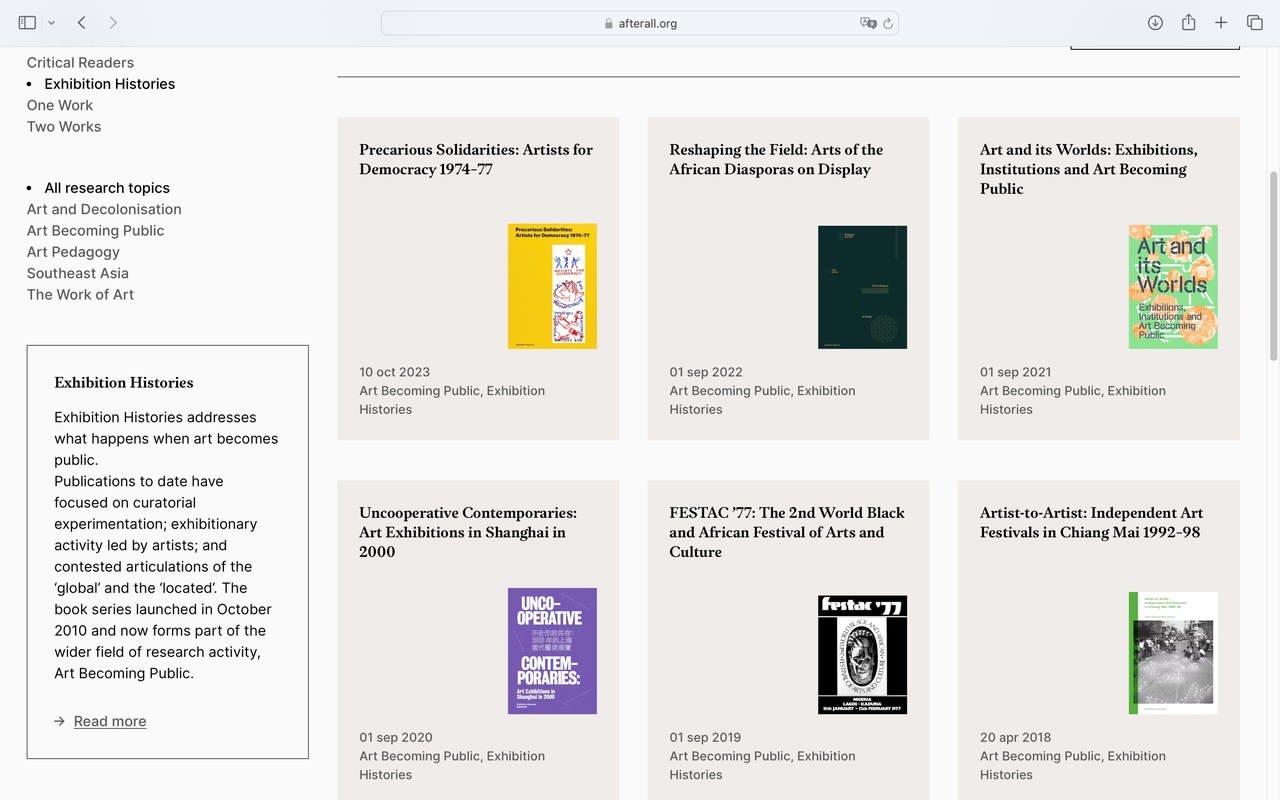
"Exhibition Histories addresses what happens when art becomes public."[29] The moment of "art becoming public," as spotlighted in the mission statement on the project website, relates to the question of the accessibility of knowledge and experience of performative arts.[30] Yet the canon formed by the authors’ selection of projects to present in this series of publications must also be brought into question, as a 2015-published edition of the Stedelijk Studies titled "Rewriting or Reaffirming the Canon? Critical Readings of Exhibition History" asserted.[31] In the context of exhibition histories, then, one can speak of a second-order canon created by the curating not of artworks but of their selection, arrangement, and their mode of becoming public.
6. Exhibitions and presentations of performance art in terms of constellations
In 2021, we published a survey of and inquiry into 37 exhibitions and presentations of performance art in the period 1994 to 2019 as part of the above-mentioned research project. Exhibition histories and performances can only be documented by means of their remains. For us that meant analysing above all catalogues/books, press releases and reviews, photos and short film trailers, and the exhibiting institutions’ websites, insofar as they had been archived. Our scope for forming opinions of how the projects were presented in the space, the appearance of the displays, or the arrangement of the artefacts, was limited. Rather, we concentrated on aspects such as the reflexive contexts, curatorial concepts, and thematic choices.
To conduct a summarizing evaluation, we shifted our focus on to the various connections linking exhibitions in different places, in the same place at different points in time, and with similar thematic emphases. As a consequence, the result is a description of constellations on different levels.[32]
4.1 Concurrent, separate, and in the same place – New York 2013: Rituals of Rented Island, Performa 13 and rAdIcAl prEsEncE. Black Performance in Contemporary Art
|
Rituals of Rented Island 31 October 2013 – 2 February 2104 Performa 13 1 November – 24 November 2013 |
|
Radical Presence Part 1: 19 September – 7 July 2013; Part 2: 14 November 2013–9 March 2014 |
Though we do not know whether or how these three events intended to correlate, their parallel temporality found comment in various reviews.[33] Because of this concurrence, I propose regarding them as a constellation of exhibitions, in different locations in the same city, that placed very different curatorial and conceptual emphases and raised very different questions.
The exhibition Rituals of Rented Islands: Object Theater, Loft Performance and the New Psychodrama – Manhattan 1970–1980, curated for the Whitney Museum of American Art in 2013/14, concentrated on performances created in the United States. More precisely, as the title suggests, it focussed on developments and events in a specific location in New York within a limited period. It was based on the premise (and observation) that numerous artists and groups experimenting with performance in the 1970s gathered in a particular borough of New York and so formed a close-knit network of players, locations, and art spaces.
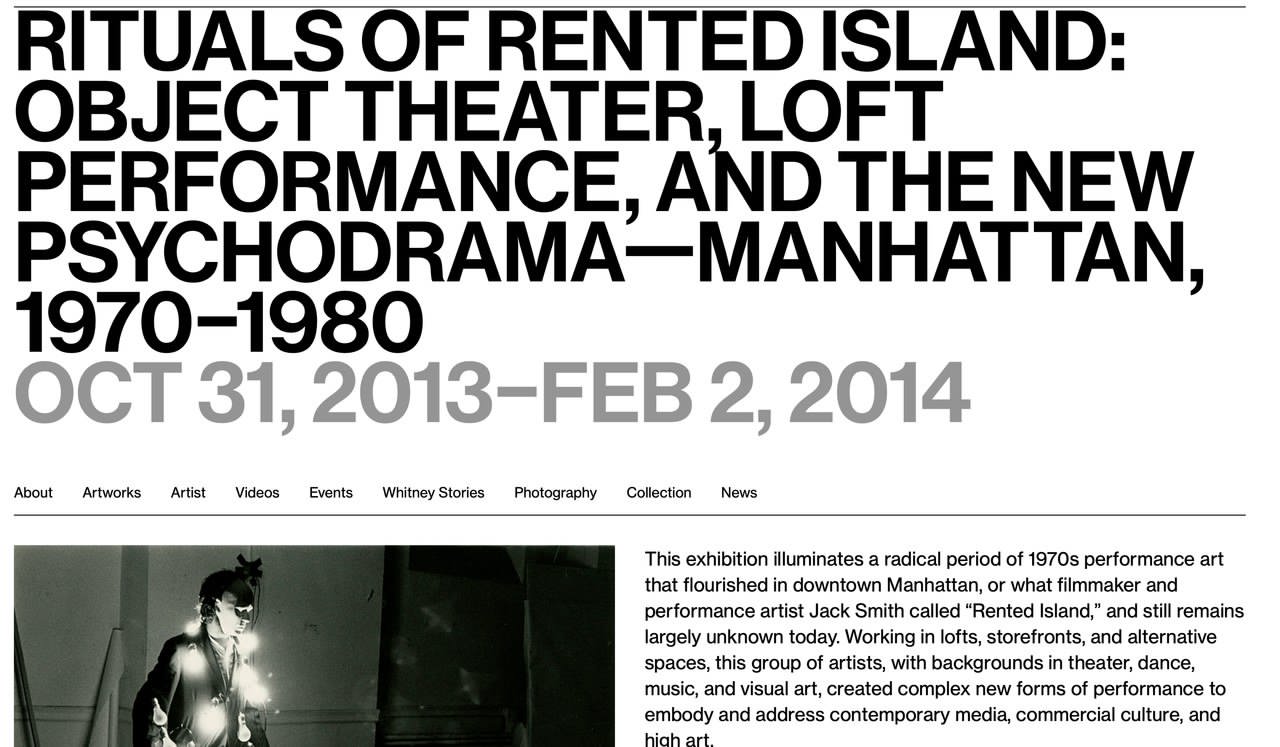
In one of the two essays that form an introduction to the exhibition catalogue, J. Hobermann tells the story of the performance artists and their actions in the context of these semi-private, semi-public, self-organized locations and spaces, and how they seized the opportunities offered by the unique urban situation in the 1970s.
There was a time in the 1970s when New York’s art world was materialized as a stage (if not an abandoned industrial moonscape) that came to be known as SoHo. . . . Space in New York was abundant and relatively cheap. The work was incubated in particular buildings: 80 Wooster Street, in which Richard Foreman stages his first performances; the exhibition-cum-work space at 112 Greene Street, where, as Peter Schjeldahl wrote, the exhibited pieces ware “scarcely distinguished from the ruined fixtures of what used to be a rag-packing factory;” filmmaker Jack Smith’s live-in movie studio-cum-theater; the Plaster Foundation of Atlantis, at 36 Greene Street; and Robert Wilson’s loft at 147 Spring Street. . . .[34]
His account ends with the changes in the city in the early 1980s, caused by the rise of the post-industrial economy.[35] The concept on which the exhibition is based, and which is reflected in its spatial and temporal frame, takes an interesting approach to accessing the developments in question, linking them not only to works by individual artists and groups but to a network of informal connections and—thanks to the gaps in the urban landscape—appropriated locations and spaces. Indeed, the Whitney Museum of American Art – the institution hosting Rituals of Rented Island which is also located in Manhattan saw itself as part of this network: "Thus, to some degree Rituals of Rented Island. . . . is a mining of the Whitney’s own past," wrote Director Adam D. Weinberg in a foreword to the exhibition catalogue.[36]
J. Sanders reveals what lies behind the three aspects making up the exhibition’s subtitle, besides different modes of artistic access, in an essay in the catalogue: "Loft performances" refers to the above-mentioned tendency to combine studio/workspace with living space and semi-public stagings; "object theatre" describes performative actions with objects, such as practiced by Stuart Sherman and John Zorn with his Theatre of Musical Objects; and the "new psychodrama"—encompassing the performances of Julia Heywards and Mike Kelley, among others—arose from an approach to theatre in which "these artists opened up intimacies and private memories, storytelling and humour, psychosexuality and trauma as newly available material […]."[37]
Some reviewers criticized the exhibition for taking a reductive perspective on the scene. Emily Colucci, for example, wrote on her website: "In the 20 or so artists highlighted in the exhibition, there were no people of colour, which was certainly not due to any lack of diversity in loft performances."[38] And Christine Shan Shan Hou wrote in Hyperallergic:
The Downtown performance scene at the time was something larger and richer than the clique of white artists featured in the exhibition. Tehching Hsieh, Tsen Kwong Chi. . . ., Adrian Piper and Sun Ra to name a few, are artists who may not have been part of the social scene at the center of “Rituals” but their presence was just as instrumental in shaping experimental performance at that time.[39]
These criticisms highlight the problems that can arise from basing the selection criteria for a contemporary exhibition on knowledge of a historical network. Because the question remains of who defines the aspects to be included and excluded and how far they are simply reproducing historical determinations. These are points that must be continually reassessed.
While critics may have accused Rituals of Rented Island of pursuing an exclusively historical-documentary approach, visitors had the opportunity to view its documents and remains of performances in relation to the contemporary perspectives on performance/dance selected for Performa 13. Performa—both the organization and the biennial festival, which now also encompasses an archive and a scholarship programme in cooperation with the Hartwig Art Foundation in The Netherlands—was founded in 2004 by Roselee Goldberg.[40] The first edition of the New York biennial was held in 2005 as Performa 5,[41] aiming to offer a comprehensive survey of contemporary international developments in live art, including historical reviews and actualizations. Performa 13, the event in question here, was the first edition to offer "national pavilions without buildings,"[42] where Norway and Poland presented works in 2013, followed by South Africa, Australia and Estonia in later editions. Visitors were, then, given insights into the diversity of performance scenes in other countries, too. Furthermore, Performa 13 reviewed surrealism and looked at various other aspects under the headings "Citizenship," "The Voice," "Radical Presence," "Language of Movement," "Film, Media, and Projection," and "Tell Me a Story."[43] The list of participating artists is very long (110 were announced) and encompasses multiple generations of internationally active performers. The programme, which can be viewed on the Performa website, notes the series Three Duets, Seven Variations, showing that there was a direct link between this festival and the concurrent exhibition Radical Presence.[44]
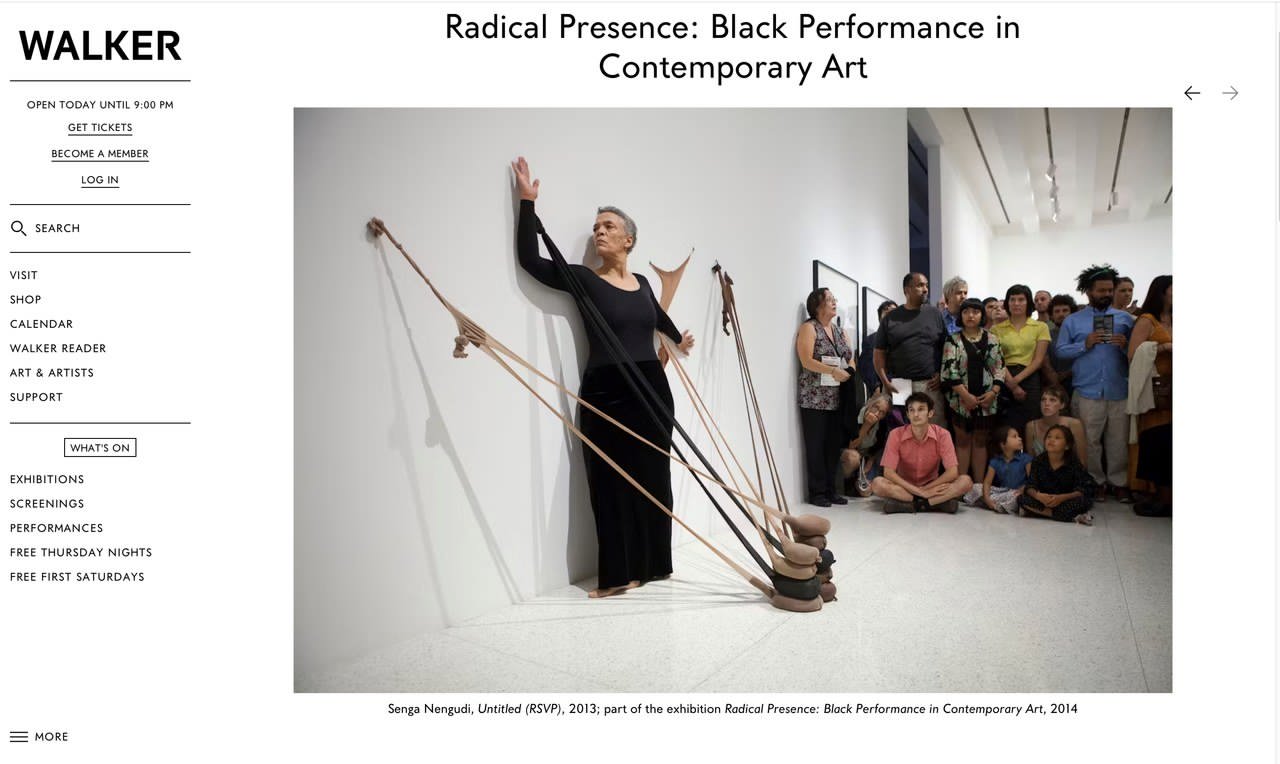
RAdIcAl prEsEncE. Black Performance in Contemporary Art was mounted (in two parts) in parallel with Performa 13 and Rituals of Rented Island in New York and explicitly dealt with artistic developments that—as the above-cited critic noted—were not represented in or were excluded from exhibitions such as Rituals of Rented Island. The exhibition’s organizers described it as one of the first to be dedicated to Black performances in a visual-arts context. Curated in 2012 by Valerie Cassel Oliver for the Contemporary Arts Museum Houston (CAMH), it showcased works going back to the 1960s by 36 artists and correlated historical developments with contemporary perspectives. Benjamin Patterson, a co-founder of Fluxus, marked an important historical reference point for the exhibition. In her essay in the exhibition catalogue, curator Valerie Cassel Oliver writes:
Performance work created by black visual artists. . . . is rooted in spectacle and, as seen in the performance documentation featured in this exhibition, occupies the liminal space between black eccentricity and bodacious behavior, between political protest and social criticism. What cannot be denied is the notion that black performance art is rooted in black cultural expression and its historical lineage. We have all seen the authentic and varied manifestations of this lineage that are not regarded as art—black speech, mannerisms, style, movement—though often elevated as spectacle and mimicked. This notion performing blackness carries with it the “aesthetic of the cool”, as Robert Farris Thompson has maintained, and becomes a foundation for how black artists move through the world.[45]
Various critics took up the connection between black performance and performing blackness—as Cassel Oliver here posits—discussing and questioning it with reference to, for instance, the participation of female artists, who made up only a third of those represented. Here, too, critics raised fundamental questions about the selection procedure, about inclusions and exclusions, and inquired into the necessity "to explore some of the limits inherent on any identity-based shows," as Alexis Clements reported from the panel discussions that accompanied the exhibition.[46]
In this context, the renowned action and concept artist Adrian Piper, whose 1980s works are read as part of the era’s feminist practice,[47] made a stand by withdrawing her video documentation on the project Mythical Being from the New York edition of the exhibition. She is quoted as commenting:
I appreciate your intentions. Perhaps a more effective way to “celebrate [me], [my] work and [my] contributions to not only the art world at large but also to a generation of black artists working in performance” might be to curate multi-ethnic exhibitions that give American audiences the rare opportunity to measure directly the groundbreaking achievements of African American artists against those of their peers in “the art world at large.”[48]
According to the CAMH press release, the exhibition encompassed, "video and photo documentation of performances, performance scores and installations, audience interactive works, as well as works created as a result of performance actions"—essentially documents and artefacts, then, that conveyed the history and narratives of performance art. This historical perspective was broadened by an extensive programme of contemporary performances,[49] staged partly in connection with the concurrently held Performa festival in New York. In an in-depth article on the exhibition, Sarah Petersen wrote that it originated in collaborative research by curator Valerie Cassel Oliver and artist Clifford Owens, which they had intended to result in a co-written book but evolved in a different direction.[50] Owen’s artistic-performative appropriation of the history of black performance plays an important part in the exhibition and informs an essay he wrote for the catalogue, describing his experiences of past black performances.
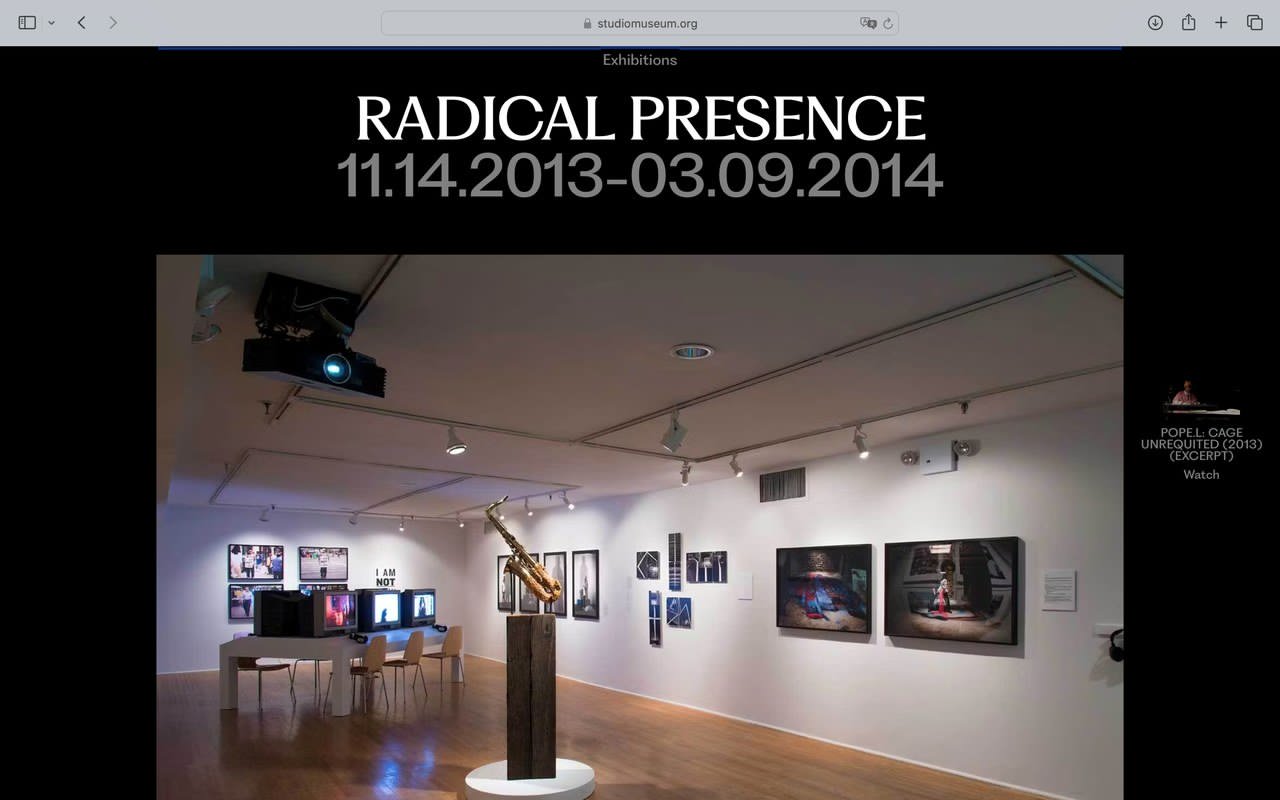
In New York, the exhibition was mounted in two locations: the Grey Art Gallery, New York University’s art museum, and the 1968-founded Studio Museum in Harlem, dedicated to African-American culture. The Studio Museum was also the site of a 1988 exhibition which the Radical Presence press release explicitly names as its predecessor and reference point: Art as a verb: the evolving continuum: installations, performances and videos by 13 Afro-American artists,[51] curated by Leslie King-Hammond and Lowery Stokes Sims. Interestingly, 11 of the 13 featured artists were women, including Adrian Piper, Maren Hassinger, Senga Nengudi and Lorraine O’Grady, who also play a part in Radical Presence. Such explicit cross-referencing forms a constellation with the potential to raise public awareness of the various temporal levels of exhibition history.
8. Shifting and Extending: From New Orleans to the Caribbean – Carnival and Performance
A 2015 exhibition that marked an equally important and innovative shift in and extension of access to performance history is En Mas’: Carnival and Performance Art of the Caribbean, which was created for the Contemporary Arts Center in New Orleans and subsequently went on tour as a "traveling exhibition," shown in five other museums and galleries, supported by Independent Curators International (ICI). The curatorial concept and premise on which the cooperation with the artists was based is summarized on the ICI website as follows:
EN MAS’ introduces performance art with a focus on the influence that Carnival and related masquerading traditions in and of the Caribbean and its diasporas have had on contemporary performance discourse and practice, in both the artistic and curatorial realms. Indeed, EN MAS’ takes into account performance practices that do not trace their genealogy to the European avant-gardes of the early twentieth-century but rather to the experiences of slavery and colonialism through to the mid-nineteenth century, the independence struggles and civil rights movements of the mid-twentieth century and population migrations to and from the former colonial centers for most of the last century.[52]
This basic idea of constructing a history of performance art detached from the history of the European, Western and predominant U.S. avant-gardes unlocked a convincing mode of access that shifted the framework of cultural influences and contextualizing narratives.
Conceived around a series of nine commissioned performances realized during the 2014 Caribbean Carnival season across eight cities in six different countries, the exhibition considers the connections between Carnival and performance, masquerade and social criticism, diaspora and transnationalism. Taking its title from a pun on Mas’ (short for masquerade and synonymous with carnival in the English-speaking Caribbean), EN MAS’ considers a history of performance that does not take place on the stage or in the gallery but rather in the streets, addressing not the few but the many.[53]
EN MAS’ opened new perspectives on the history and practice of performance/art, for one, by commissioning artistic projects directly connected with the carnival season, i.e., with street events involving a large number of players and an even larger number of spectators. Curator Claire Tancons speaks of "processional performances":
Whereas mas is scripted within a cultural text that prompts its knowing performers to cull from a database of movements and behaviours that together form Carnival, my processional performances create their own meta-scripts from a combination of the individual artists’ scripts and elaborate their own direction that culminate in texts collaboratively authored with the artists and the performers.[54]
Moreover, it responded to the political dimension of carnival-like, explicitly activist processions such as Carnival Against Capital in London (1999 and 2013) and Carnival Against Racism in Berlin in 2016.[55]
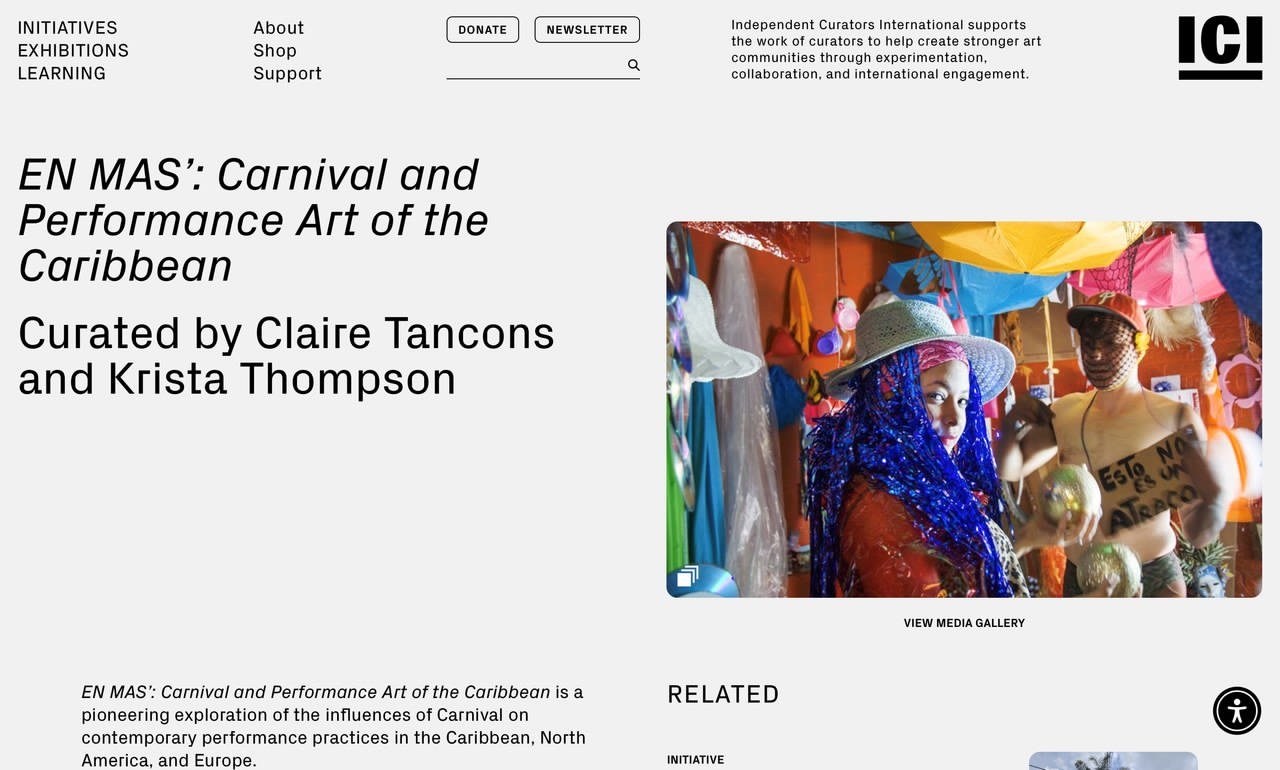
The masquerade/masks play a key role both in history and in contemporary, artistically framed and curated carnivalesque practice and they, in turn, are closely related to the genesis of identity politics and the constituting of temporary communities. Kobena Mercer describes this potential future role of masks as a "joyful dispossession of identity"[56] in an essay in the catalogue:
The elective loss of identity in carnival’s dispossessive matrix is enjoyable as it emancipates everyone from the ego’s obligations to be a selfsame “I”. Mas’ reminds us that every identity is incomplete, for “I” always contains a multitude of possible selves, not all of which get to be actualized.[57]
As evident from the descriptions on the ICI website and photos on curator Claire Tancon’s website,[58] the exhibition mainly showed the medial re-renderings of performances by well-known photographers and filmmakers from the Caribbean as well as some (sculptural) objects that were used in performances. In 2014 Claire Tancons was invited to curate a version for the Tate Modern in London[59] which took place in close connection with the Notting Hill Carnival.
9. Concluding remarks
Activities establishing a canon of performance art works, as I mentioned at the outset, initially focussed on the (supposedly) central Anglo-American and European art contexts.[60] Due to a postcolonial change in perspective and critical efforts in various fields of curating, this approach to canon formation has slowly started to change. This shift is tangible in the constellation described in the fourth part of my article.
"Reading together" various exhibitions as a constellation with at least one common point of reference leads to a new approach to the presentation of performance/art. While the example considered here is based on geographical reference points (New York/New Orleans-Caribbean) and the events’ simultaneity, elsewhere I have inquired into and correlated thematically based or consecutive developments observed in one location. This access to the history of performance-based arts "becoming public" allows us to observe and explore shifts in curatorial decision-making and an increasing porousness of institutions.
1 From 2012 to 2019, Franz Anton Cramer and I conducted a research project titled Media and constitutive systems: Archiving performance-based art (project 218477758), funded by the DFG. Some of our findings were published in the online journal MAP media archive performance <http://perfomap.de> [accessed 25 October 2024].
2 See B. Büscher, ‘Lost & Found. Archiving Performanceʼ, #1, MAP (2009), <https://perfomap.de/map/ii.-archiv-praxis/lost-found-archiving-performance> [accessed 25 October 2024]; B. Büscher, F.A. Cramer, Bewegen, Aufzeichnen, Aufheben, Ausstellen: Archivprozesse der Aufführungskünste, Leipzig & Berlin, 2021, <https://doi.org/10.25366/2022.2> [accessed 25 October 2024].
3 Curator Barbara Clausen, e.g., raised the question of how far «the current socio-political and cultural demand for appropriating actionist gestures of the past is linked to the current [tendency towards] institutionalizing and commercializing performance art» (B. Clausen, After the Act. The (Re)Presentation of Performance Art, Vienna, Museum Moderner Kunst, 2007, p. 9).
4 See P. Phelan, Unmarked. The Politics of Performance, New York, Routledge, 1996. For a summary, also: H. Roms, ‘Eventful Evidence. Historicizing Performance Art’, in MAP #2, 2010,
5 Cf. S. Omlin, ‘Perform the Space: Performance Art (Re)Conquers the Exhibiton Space’, in OnCurating #15, 2012, pp. 3-12; R. K. Williams, ‘A Mode of Translation: Joan Jonas’ Performance Installations’, in S. Berrebi, H. Folkerts (eds.), Stedelijk Studies, Issue #3, Fall 2015, <https://stedelijkstudies.com/journal/a-mode-of-translation-joan-jonass-performance-installations/> [accessed 25 October 2024].
6 M. Muhle, ‘The Times of Reenactment. From Minimalism to Time-Based Media,’ in B. V. Bismarck et al. (eds.), Timing. On the Temporal Dimension of Exhibiting, Berlin, Sternberg Press, 2014, pp. 47-64.
7 See M. Abramović, Seven Easy Pieces, Milan, Charta, 2007; B. Büscher, ‘Lost & Found’, 2009; A. Jones, ‘The Artist Is Present: Artistic Re-enactments and the Impossibility of Presence’, TDR The Drama Review, 55, 1, 2011, pp. 16-45.
8 C. Bishop, ‘Black Box, White Cube, Gray Zone. Dance Exhibitions and Audience Attention’, TDR The Drama Review, 62, 2, 2018, p. 26.
9 E. Meyer-Hermann, A. Perchuk, S. Rosenthal (eds.), Allan Kaprow – Art as Life, London, Thames and Hudson, 2008.
10 G. Giannachi, ‘At the edge of the living present: re-enactments and re-interpretations as strategies for the preservation of performance and new media art’, in Ead., J. Westermann (eds.), Histories of Performance Documentation. Museum, Artistic and Scholarly Practices, London/New York, Routledge, 2018, p. 115.
11 On this issue, Maria Muhle writes: «But within the strategies of reenactment, this historical dimension relates to another temporality: the narrative time that is concerned with the conditions of representation, i.e. the performative character of reenactment that relates it to the already mentioned emergence of performative art forms in the 1960s. On a cultural-technical level, these temporalities operate in an opposite manner: while historical time is negated by reenactments through their hyper-mimetic and immersive representational mode, the extension or duration of performative time is the fundamental narrative mode of reenactment strategies» (M. Muhle, ‘Times of Reenactment’, cit., p. 48).
12 R. Schneider, Performing Remains: Art and War in Times of Theatrical Reenactment, London, Routledge, 2011, p. 6.
13 S. Lütticken, ‘Introduction’, in Id. (ed.), Life, Once More. Forms of Reenactment in Contemporary Art, Rotterdam, Witte de Wit, 2005, pp. 5-7.
14 C. Bishop, ‘Black Box, White Cube’, cit., p. 27.
15 B. Cvejic, A. Vujanovic, Public Sphere by Performance, Berlin, b_books, 2015, p. 72.
16 C. Bishop, ‘The Perils and Possibilities of Dance in the Museum: Tate, MoMA and Whitney’, Dance Research Journal, 46, 3, 2014, pp. 63-76; see also the interviews in G. Giannachi, J. Westerman, Histories, cit.
17 C. Wood, ‘People and Things in the Museum’, in M. Copeland, J. Pellegrin (eds.), Choreographing Exhibitions / Chorégaphier l’exposition, Dijon, Les presses du reel, 2013, p. 113.
18 C. Wood, ‘People and Things’, cit., pp. 117-118. She is quoting here from: B. Latour, Reassembling the Social, Oxford, Oxford University Press, 2007, pp. 82-83.
19 See also the introductory premiss to The Explicit Material: «A life rather than a ready-made reality, the work of art is subject to change depending on the complex system of material relations in which it exists» (H. B. Hölling, F. G. Bewer, K. Ammann (eds.), The Explicit Material, Inquiries on the Intersection of Curatorial and Conservation Cultures, Leiden/Boston, Brill, 2019, p. 1).
20 G. Guy, Theatre, Exhibition, and Curation. Displayed and Perfomed, New York/London, Routledge, 2019, p. 5.
21 B. v. Bismarck, ‘Ausstellen und Aus-setzen. Überlegungen zum kuratorischen Prozess’, in K. Busch, B. Meltzer, T. V. Oppeln (eds.), Ausstellen. Zur Kritik der Wirksamkeit in den Künsten, Zürich/Berlin, Diaphanes, 2016, pp. 142-143.
22 See, e.g., P.J. Schneemann, ‘Spielräume: Die Ausstellung als Bühne für das Publikum – zwischen Entmündungen und Ermächtigung’, in V. Kobi, T. Schmutz (eds.), Les lieux d’exposition et leurs publics / Ausstellungsorte und ihr Publikum, Berne, Peter Lang, 2013, pp. 121-144; H. Foster, ‘After the White Cube’, <https://www.lrb.co.uk/the-paper/v37/n06/hal-foster/after-the-white-cube> accessed 25 October 2024.
23 P. O’neill, ‘The Curatorial Constellation and the Paracuratorial Paradox’, The Exhibitionist, 6, 2012, pp. 55-61.
24 B. v. Bismarck, Das Kuratorische, Leipzig, Spector, 2021, pp. 137-145. On the concept of the constellation in philosophy, see, e.g., A. Lehr, Kleine Formen. Konstellation/Konfiguration, Montage und Essay bei Adorno, Benjamin und anderen, Norderstedt, Books on demand, 2003.
25 B. v. Bismarck, ‘Archives on Show. An Introduction’, in Ead. (ed.), Archives on Show. Revoicing, Shapeshifting, Displacing. A Curatorial Glossary, Berlin, Archive Books, 2022, p. 70.
26 B. v. Bismarck, Das Kuratorische, cit., p. 111.
27 F. Vogel, ‘Notes on exhibition history in curatorial discourse’, On Curating, Issue 21, January 2014, <https://www.on-curating.org/issue-21-reader/notes-on-exhibition-history-in-curatorial-discourse.html> accessed 25 October 2024.
28 L. Steeds, D. Morris, C. Esche, B. Choy, ‘Exhibition Histories Through the Shared Art of Memory’, in L. Steeds, D. Morris, C. Esche, B. Choy (eds.), Art and Its Worlds. Exhibitions, Institutions and Art Becoming Public, London, Afterall, 2021, pp. 15-16.
29 <https://www.afterall.org/projects/exhibition-histories/> accessed 25 October 2024.
30 See the eponymous research and publication website, coordinated by the Afterall editors and affiliated to Central Saint Martin’s (CSM) University of the Arts London: <https://www.afterall.org/research/art-becoming-public/> accessed 25 October 2024.
31 L. Boersma, P. Van Rossemv, ‘Rewriting or Reaffirming the Canon? Critical Readings of Exhibition History – Editorial’, in Stedlijk Studies Issue #2, Spring 2015, <https://stedelijkstudies.com/journal-archive/issue-2-exhibition-histories/> accessed 25 October 2024.
32 B. Büscher, ‘Ausstellungen und Präsentationen zu Performance(kunst) und ihren Geschichten. Zusammenfassende Auswertung der ausgewählten Beispiele (1994-2019)’, in B. Büscher, F. A. Cramer, Bewegen, Aufzeichnen, Aufheben, Ausstellen, 2021, pp. 116-160.
33 Nikki Columbus writes in Artforum on Performa 13: «The month [i.e. November 2013] was a mix of multiple curators’ projects and co-presentations with museums and theaters, spread throughout Manhattan, Brooklyn, and the Bronx» (Artforum, April 2014, <https://www.artforum.com/print/reviews/201404/performa-13-45776> accessed 25 October 2024). In a review of Rituals of Rented Island in the New York Times, Holland Cotter refers to the concurrently held PERFORMA 13. See H. Cotter, ‘Nothing to Spend, Nothing to Lose’, New York Times, 31 October 2013, <https://www.nytimes.com/2013/11/01/arts/design/rituals-of-rented-island-performance-art-at-the-whitney.html> accessed 25 October 2024 and J. Haber, e.g., reviews Rituals of Rented Island and Radical Presence in connection with each other (see <https://www.haberarts.com/bperform.htm> accessed 25 October 2024).
34 J. Hobermann, ‘Like Canyons and Rivers. Performance for Its Own Sake’, in J. Sanders (with J. Hobermann) (eds.), Rituals of Rented Island. Object Theater, Loft Performance, and the New Psychodrama – Manhattan, 1970-1980, New Haven/London, 2013, pp. 9-24.
35 Ivi, p. 24.
36 A. D. Weinberg, ‘Foreword’, in J. Sanders, J. Hobermann, Rituals, 2013, pp. 6-8.
37 J. Sanders, ‘Love is an Object’, in Id., J. Hobermann, Rituals, 2013, p. 35.
38 E. Colucci, ‘Rituals of Reductive Island’, filthy dreams, 10 November 2013, see: <https://filthydreams.org/2013/11/10/rituals-of-reductive-island-why-i-hated-the-whitneys-rituals-of-rented-island/ > accessed 25 October 2024.
39 C. Shan Shan Hou, ‘Selected Secrets from a Disillusioned Generation’, Hyperallergic, 16 November 2003, <https://hyperallergic.com/93292/> accessed 25 October 2024.
40 Roselee Goldberg wrote one of the first broad histories of performance art: R. Goldberg, Performance. Live Art 1909 to the Present, New York, Abrams, 1979.
41 <https://performa-arts.org> [accessed 25 October 2024].
42 See also the Performa website, ‘Pavilions without Walls’, <https://performa-arts.org/pavilions-without-walls> accessed 25 October 2024; also RoseLee Goldberg in conversation with Elena Tavecchia, in Mousse Magazine, 21 November 2013, <http://moussemagazine.it/peforma13/> accessed 25 October 2024.
43 These were in any case the chapter headings in a retrospectively published book on the festival: R. Goldberg, K. Madden (eds.), Performa 13: Surrealism / The Voice / Citizenship, New York, Performa, 2015.
44 See, e.g., http://13.performa-arts.org/event/tameka-norris-and-senga-nengudi accessed 25 October 2024 and http://13.performa-arts.org/event/benjamin-patterson-penny-for-your-thoughts accessed 25 October 2024].
45 V. Cassel Oliver, ‘Putting the Body on the Line. Endurance in Black Performance’, in Contemporary Arts Museum Houston (ed.), Radical Presence. Black Performance in Contemporary Art, Houston, CAMH, 2013, p. 14.
46 A. Clements, ‘Animating the Archive’, Hyperallergic, 10 October 2013, <https://hyperallergic.com/86044/animating-the-archive-black-performance-arts-radical-presence/> accessed 25 October 2024.
47 Naomi Beckwirth addresses Adrian Piper’s work, among other things, in her catalogue text, writing: «In other words, the Mythical Being stands as a seminal work of self-fashioning that both posited and critiqued models of gender and racial subjectivity, a project that historically has been ascribed to feminist art practice (and all identity-politics art in general» (N. Beckwirth, ‘Dark Mirrors. Performance Documents as Bodily Evidence’, in Contempotaty Arts Museum Houston, Radical Presence, 2013, p. 30).
48 Artforum, News, 31 October 2013, <https://www.artforum.com/news/adrian-piper-pulls-out-of-radical-presence-exhibition-at-grey-art-gallery-43862> accessed 25 October 2024.
49 Videos showing excerpts of the performances staged in Houston can be viewed online: <https://www.youtube.com/watch?v=a_LJPiR1mwc> accessed 25 October 2024; <https://www.youtube.com/watch?v=tNIANy0Lr14 > accessed 25 October 2024.
The New York edition had its own website which is still accessible: <https://greyartmuseum.nyu.edu/exhibition/radical-presence-091013-120713/sec/programs/> accessed 25 October 2025; material and videos of the performances can also be seen on the Walker Art Center website: <https://walkerart.org/calendar/2014/radical-presence> accessed 25 October 2024.
50 S. Petersen, ‘Risk Assessment’, X-TRA Contemporary Art Quarterly, 17, 4, 2015, pp. 4-29.
51 For the exhibition catalogue reference and a scan of the catalogue, which can be viewed on the website, see: <https://library.nga.gov/discovery/fulldisplay/alma994114978804896/01NGA_INST:NGA> accessed 25 October 2024.
52 See the Independent Curators International website: <https://curatorsintl.org/exhibitions/18077-en-mas> accessed 25 October 2024.
53 See the Contemporary Arts Center New Orleans website: <https://cacno.org/en-mas> accessed 25 October 2024.
54 C. Tancons, ‘Spectacular Insurgency. Carnival, the Curatorial, and the Processional (2008-)’, in F. Malzacher, J. Warsza (eds.), Empty Stages, Crowded Flats. Performativity as Curatorial Strategy, Berlin, Alexander Verlag, 2017, pp. 116-117.
55 Ivi, p. 114. After this exhibition, curator Claire Tancons continued her work with this mode of performance in other projects. Summarizing, she writes: «Though curated or directed, these processional performances, rooted as they are within what I refer to as and situate within a Caribbean cultural consciousness, one that is de facto postcolonial, continue to conjure up the vision of Carnival and provoke the elating immersive experience of a multisensorial multitude gathering above and beyond any narrative script, curatorial selection, and directorial scenario – a testament to both Carnival’s inner organizational principle and utter incuratability and a pending promise to continue cultivating its potential for performing (ins-)surgency. A sort of spectacular insurgency lived out in processional performance?» (Ivi, p. 118).
56 K. Mercer, ‘Theorizing Carnival: Assemblages, Becomings, Cross Cultural Machines’, in C. Tancons, K. Thompson (eds.), En Mas. Carnival and Performance Art of the Caribbean, New Orleans/New York, 2015, p. 60.
57 Ivi, p. 68.
58 See <https://www.clairetancons.com/curating/en-mas-carnival-and-performance-art-of-the-caribbean-2/> [accessed 25 October 2024].
59 On the London edition, see: <https://www.tate.org.uk/whats-on/tate-modern/bmw-tate-live-2014-performance-events/bmw-tate-live-hill-down-hall-indoor> accessed 25 October 2024.
60 This emerges from publications on performance such as the first editions by Roselee Goldberg (R. Goldberg, Performance, 1979) and Marvin Carlson (M. A. Carlson, Performance. A Critical Introduction, London/New York, Routledge, 1996).