Allan Kaprow, in his 1966 book Assemblages, Environments, and Happenings, argued that "the most forward looking" art is transient, ephemeral and resists objectification and commodification. "There is no fundamental reason," he wrote, "why it should be a fixed, enduring object to be placed in a locked case… If one cannot pass this work on to his children in the form of a piece of ‘property,’ the attitudes and values it embodies surely can be transmitted."[1] Kaprow’s stance toward the art object came to be seen as emblematic in the realm of performance art as evidenced by the continued insistence that ephemerality is a defining characteristic of performance.[2] RoseLee Goldberg summarizes the essential points by saying of performance that "although [it was] visible, it was intangible, it left no traces and it could not be bought and sold."[3] Over time, and until the recent past, this perspective, which sets performance against the art object and all of the things that go along with objectification—including commodification and musealization—has become the dominant way of understanding the historical emplacement of performance art and the impulses behind it.[4]
But what if, rather than defining performance as a form that is ineluctably opposed to the object, we instead considered performance art as an artistic genre that necessarily includes and engages with objects and objecthood? What if we viewed performance, not from the perspective of the impossibility of its institutionalization and, specifically, musealization, but accepted it as just another form entering the institution of memory and becoming an "object" of collection, conservation and display? What if performance, by manifesting duration and materiality, cannot be divorced from the object or conceptualized apart from it? What if it is through duration, repetition and repeatability that performance takes on the aura of an object that can be encountered repeatedly at different times and in different places?
In this essay, combining the disciplinary perspectives of performance studies, art history and conservation, we draft, using selected examples of performance artworks, a larger cosmos of performance in which the action, whether body or object-based, will be seen as just one of its time-bound elements and not necessarily a privileged one. Our examples do not constitute a comprehensive overview of performance art. Rather, we selected them to illustrate the relationships between performance and objecthood we identify and to assert continuities and differences among performance art works from different historical moments. We begin by drawing parallels between performance and other process-based and mutable artworks, none of which escape the logic of the art object even as they test its limits. We argue that objects related to performances are not mere remnants of otherwise ephemeral processes: they exist in time and are performative in themselves. We further argue that duration and repetition make performance persist in ways akin to the perpetual availability of physical objects.[5] Venturing into the mechanisms of the institutionalization of performance, we will observe a rich material history of this form that questions assumptions about its ephemerality and lack of endurance and object and asserts, above all, that the work of performance art is not limited to an "original" event. Performance persists in – and as – the objects that make it continuously available to experience and interpretation.
1. Process versus Product
One point of departure for reconceiving performance’s relationship to the object takes into account the ways the art object itself was reconceptualized at the time of performance art’s development in the West during the 1960s. Lucy Lippard’s characterization of this era as that of "the dematerialization of the art object" is perhaps not entirely accurate.[6] Rather than being dematerialized, the art object was rematerialized through a new understanding of its materiality as a series of contingent and temporary conditions rather than a steady state. Far from the "enduring object . . . in a locked case" posited by Kaprow, the objects realized through art practices of the 1960s that emphasized process and temporality over stasis were neither lasting nor intrinsically precious. Richard Serra’s splashed lead pieces from 1968-9 are examples. Critic Jeffrey Weiss writes:
The production of a splash/cast work occurs in a series of basic steps. Tearing pieces of lead from industrial rolls, Serra heats them in a vessel that sits above an acetylene flame. He then transfers the molten lead from the pot and deposits it along the juncture of wall and floor. The artist has described the procedure as a largely methodical one that advances "ladleful by ladleful," beginning at one end of the wall and finishing at the other. When the lead cools, it bonds to the site, converting the juncture into a kind of container, a mold for the lead. This interaction locks the work into a dependent relation to the space of the room.[7]
Since Serra’s lead splashes were site-specific works made for temporary exhibitions, it is not surprising that they proved to be ephemeral.[8] Indeed, the image most often used to illustrate these works is not of a lead splash itself but, rather, an iconic photograph by Gianfranco Gorgoni of Serra throwing lead with a gigantic ladle to make a piece at the Castelli Warehouse in 1969. Although Serra’s lead splashes are considered to be sculptural works, Serra’s emphasis of process over object redefined the nature of the sculptural object. This object is no longer fixed and singular—each iteration of Serra’s lead-splashing process is as much "the object" as any other, no matter what differences there may be among them. The object no longer aspires to permanence. As Serra himself observed, after the splash piece at the Castelli Warehouse was dismantled, "the lead went right back in the hopper," presumably to be used again.[9] The object is no longer self-sufficient but becomes primarily a record of Serra’s actions in making it. In some ways, the actual lead installations are secondary to the idea of making them and the fact of having done so.
In another example, Niki of de Saint Phalle staged "shooting" performances across cities from Paris to Stockholm, Amsterdam and Los Angeles in the early 1960s, using firearms to pierce assemblages of objects mounted on wood and coated in plaster. These often freestanding, pristine white compositions contained bags of liquid paint and spray cans that ruptured upon impact, causing colorful paint to splatter, drip and spill across the surfaces. Although these striking "paintings"— marked by a sense of violence, disruption and psychological tension—now adorn the white cubes of galleries, they are, in essence, the remnants of the performance-events that brought them to life. One could argue that de Saint Phalle’s works, like Serra’s lead splashes, stand as the outcomes of performative actions. Moreover, they are not mere static objects but assert their intimate relationship to the actions that brought them into being. Their objecthood is far from static or fixed. Rather, along the axis of material instability and fragility, cast against the sterile walls of exhibition spaces, these works persist through and in a slow performance. Noticing pays off. This intricate performance of objects highlights the failure of exclusively holding onto—or even the inevitable forgetting of—the originating event.
The understanding of objecthood that informs de Saint Phalle’s shoot paintings and Serra’s sculptural interventions is thus very similar to the objecthood of performances, which are also temporary stagings derived from processes that exist prior to them. These stagings, like the dramatic photographs of Serra throwing lead or of de Saint Phalle’s elegant positioning on a ladder in a white uniform and aiming a firearm at a tableau, both serve as records of the underlying process and throw off other objects that either were involved in the process, resulted from it, or document it. From this perspective, it is more accurate to say that performance art, rather than rejecting or resisting objectification, participated in an ongoing redefinition of the art object as it developed across artforms in the late 1960s and early 1970s, giving rise to a mutually defining, dialectical relationship between performance and object.
2. The Musealization of Performance art
Although the inclusion of work by Serra, de Saint Phalle and other visual artists who emphasized process over product cracked open the museum door to art informed by a performative sensibility in exhibitions as early as the late 1960s, museums did not consider performance art to be a category congruent to traditional art forms until well into the 21st century. Tate Modern in London began collecting performance art works in 2005. The Museum of Modern Art in New York founded its Department of Media in 2006; it became the Department of Media and Performance in 2012. The Whitney Museum of American Art appointed its first curator of performance also in 2012, with the Guggenheim Museum in New York following suit soon thereafter. It is noteworthy that commentaries on The Artist Is Present, Marina Abramović’s exhibition at the Museum of Modern Art in 2010, both at the time and retrospectively, often treat Abramović’s exhibition as a watershed moment in performance art’s entry into the museum.[10]
The International Council of Museums (ICOM) defines musealization as "the operation of… giving [something] a museal status, transforming it into a musealium or ‘museum object,’ that is to say, bringing it into the museal field." This definition goes on to say that musealization, "as a scientific process, necessarily includes the essential museum activities: preservation (selection, acquisition, collection management, conservation), research (including cataloguing) and communication (via exhibition, publications, etc.)."[11] Virtually all these activities are problematic with respect to performance: how is performance, a form celebrated for its ostensible immateriality and ephemerality, to be acquired, collected, conserved and presented?
It is unsurprising that recent approaches to acquisition, exhibition and conservation address these questions, which have become central to the conservation of process—and performance—based artworks as well as the conservation of so-called "time-based media" more generally.[12] Suffice it to say that while conservation has made great efforts to address the event-based aspects of performance art, its focus on the object dimension has long been integral to the conservation of paintings, sculptures and other object-based forms of cultural expression.
In an article on performance cataloging and archiving, Christine Manzella and Alex Watkins define three categories of objects through which a performance may become a musealium: documentation (records of the performance as an event), artifacts (objects used in the performance that continue to exist after and apart from it) and ephemera ("announcement, press releases, reviews, photographs and correspondence").[13] The traditional view of performance art as resistant to objectification usually leads to a dismissive attitude toward all three kinds of performance remnants as things that are ultimately separate from and secondary to the "real thing," the event itself. One of our objectives here is to challenge this supposition. In the next sections, we present case studies that focus on the exhibition of performance through its artifacts and documentation, followed by a discussion of how performance has become a musealium in the form of an event.
3. Object in and as Performance – Abramović’s Rhythm 0
Marina Abramović’s Rhythm 0 (1974), displayed over the course of several years at the Tate’s “Performer and Participant,” and recently prominently present as a room installation in her traveling retrospective making a stopover at the Kunsthaus Zurich (October 25, 2024-February 16, 2025), exemplifies the intricate relationship between performance, documentation and artifact—being not solely a product or a record of the event, but an amalgamation of these aspects, alongside reinterpretation and reperformance.

A longish table covered in white cloth presents to the viewer a set of neatly arranged artifacts, such as a hammer, a saw, a fork, a bowler hat, a lipstick, a shawl, a blade, a Polaroid camera, a pistol, among many others.[14]Above this table, a series of documentary images is displayed from a digital projector; on the right-hand side of the table, we see an empty chair. The originating performance took place at Studio Morra, Naples. The instructions for Rhythm 0 read as follows: "There are 72 objects on the table that one can use on me as desired. Performance. I am the object. During this period I take responsibility. Duration: 6 hours (8pm-2am)."[15] Like her other works in the series Rhythm, such as Rhythm 2 and Rhythm 5 from 1974, Rhythm 0 performed an extreme act pushing the artist to her limits, providing Abramović with an insight into what Peggy Phelan sees as "the line between strength and vulnerability."[16]A part of a non-sequential series, the work resulted from Abramović’s strict upbringing in post-war Yugoslavia, where control, discipline and violence coalesced.[17] The objectification of the performer’s body echoed, if only to an extent, Yoko Ono’s earlier Cut Piece that premiered in 1964 at Yamaichi Concert Hall Kyoto. While Ono’s work encourages the participant to cut away pieces of her attire in the spirit of taking and giving (at least in its initial iteration and pre-feminist readings), in Rhythm 0, Abramović permitted the audience to freely manipulate her body with a set of tools offered on a table while she remained determinedly passive. The event reached a dangerous point when a loaded gun was moved to her neck[18] —one of the reasons why Abramović refuses to allow the piece to be reperformed (while otherwise performing ‘reconstructions’ as one of the strategies of performance survival, see, e.g., Seven Easy Pieces, 2005).[19]
None of these emotions seem to inhere in current viewers’ interactions with the static display of the table accompanied by a projection. Moreover, and despite various authors’ claim that these are in fact the relics of the 1974 performance, not all table objects formally coincide with their historical precedents, and none of them is materially identical with the 1974 objects. The objects had been replaced by newer objects or added in later years. In fact, as Mareike Herbstreit has noted, and the artist confirmed to these authors, several tables exist in collections from London to New York equipped with a varying assemblage of objects.[20] This seems even more curious since at least several of the "originals" from the 1974 event were saved. Although Abramović explicitly advised Studio Mora to dispose of the artifacts after her 1974 performance of Rhythm 0—she insisted "there are no original objects"—the owner decided to keep them. No doubt, and somewhat against this essay’s claim, Abramović capitalizes on the exclusive meaning of performance as an event. In contrast to artists like Joseph Beuys or Chris Burden, who, each in their own way, selectively enshrined performance artifacts in vitrines, Marina Abramović is known for not retaining these artifacts but instead repurchasing them for subsequent performances, such as the knives used in Rhythm 10 (1973) or the brushes for Art Must Be Beautiful/Artist Must Be Beautiful (1975). Devin Zuber notes that artifacts began to appear in Abramović’s oeuvre following her separation from Ulay (Frank Uwe Laysiepen, a long term companion of Abramović), a pivotal moment in which she established herself as a solo artist. Although they are crafted from wood or crystal, Abramović has collected and exhibited these objects not as sculptures but as tools, referring to them as "Transitional Objects."[21]
Jorge Otero-Pailos employs Donald Winnicott’s concept of the transitional object to describe items that help infants navigate the distinction between inner and outer worlds.[22] These objects enable socialization and shape social relations. Otero-Pailos argues that the need for transitional objects persists into adulthood and that cultural objects might function as such, without which our survival would not be possible. If "preservation allows us to feel as if our lives depend on the survival of our native land or historic neighborhood" and "we exist only to the degree that our heritage survives, and without this heritage, some vital part of us would die,"[23] then performance objects, as transitional objects, and contingent on the context of the performative operation, can acquire the meaning of heritage objects necessary to survival – not only the survival of the performance as an artwork but also our survival as participants in culture.
But what difference does it make that Abramović’s table artifacts at the Tate are not historical, but rather have been added in the course of this presentation? Can these objects stand in for an action that has been and that yet might become, like Serra’s blobs of lead? If these objects were not really there, that is, if none of them are relics from that historical event, what are they, and how does it matter? Lastly, how does the ban on reperformance of the 1974 Studio Mora event stand in a striking contrast to the multiple reinterpretations, or re-performances, of the table with its changing object assemblage? Like a relic that yet needs to be touched by a saint, or like a temporally skewed event in which the object precedes the action from which it will have originated, Abramović’s object assemblage reverse-engineers, in a way, the performance work, in the Future Perfect of potential scenarios.
Object by object, through space and across time, the work is solidly grounded in the rhythm of its repeated, cross-temporal materializations that reject any confinement of the work solely to its initiating act. It is this recurrent display, recitation and circulation, as Adrian Heathfield has noted,[24] including its socialization, that preserves the work from the oblivion of time. But Rhythm 0’s artifactual presence does more: it reinscribes Abramović’s enunciation "I am the object" into the performance, but rather than into the performance-act, this time into its extended material life in a gallery space. This display, with its orderly neatness and clear structure – reinforced by the bizarre presence of plastic fruits and various security measures like nylon threads and zip ties securing the scissors and gun in recent displays—contrasts, almost grotesquely, with the improvised, messy and blood-stained corporeal presence of the interacting bodies in the projected images from fifty years ago.
The duration of the initiating event—although often referred to as a "durational performance" because it lasted several hours—occurs in a disproportionate relation to the material duration of these pseudo-remains. That is where their power to endure lies. Despite Heathfield’s claim that Abramović’s most transient works persist through their singularity in spectators’ art experiences and critical readings, the artwork’s enduring power here lies in the physical presence of these artifacts and their reliably recurring appearances over time.[25]
But these tables’ distinct object assemblies featured on the art world’s prominent stages do not pose the dialectic between the life (of the event) and the presupposed non-life of this "still life." In a staged setting, and evoking a dramaturgy of a supposed stasis, Rhythm 0’s objects pronounce a livelihood by performing their own material presence. Paralleling Kaprow’s observation that "since the first decade of [the 20th] century, pictures and constructions have more and more exhibited a short life span, betraying within a few years, or even months, signs of decay," as well as Herbert Blau’s famous dictum that, in the theatre, it is an "ontological fact that the one performing there, that one, is dying in front of your eyes,"[26] these objects succumb to decay and disintegration at different paces and with different intensities. Ostensibly static objects thus participate in the existential temporality of performance.
4. Parsing Authenticity: Paik’s Necktie
Twelve years before the debut of Rhythm 0, during the first Fluxus festival—Fluxus: Internationale Festspiele Neuester Musik—held at the Museum Wiesbaden in September 1962, Nam June Paik knelt on the floor of the museum’s lecture hall. Positioned between the auditorium and the proscenium, he began to crawl backward in a rhythmic sequence of expressive movements, dragging his necktie along an elongated sheet of paper. Historical records show that Paik repeatedly soaked his necktie in a mixture of ink and tomato juice, using it as a brush to create a roughly straight line.[27] After this, he plunged his whole head into the mixture to continue this act of calligraphy making as an embodied, corporeal experience[28] —a uniquely autographic gesture in what might otherwise be considered an allographic work.[29] Indeed, this act was a realization of La Monte Young’s Composition 1960 #10, which instructed "draw a straight line and follow it," and which Paik had rehearsed the year prior in Cologne.[30] Thus Zen for Head, one of Paik’s most frequently cited and historically reinterpreted works, was released into history, illustrating Fluxus’ practice of borrowing and reworking concepts among peers.
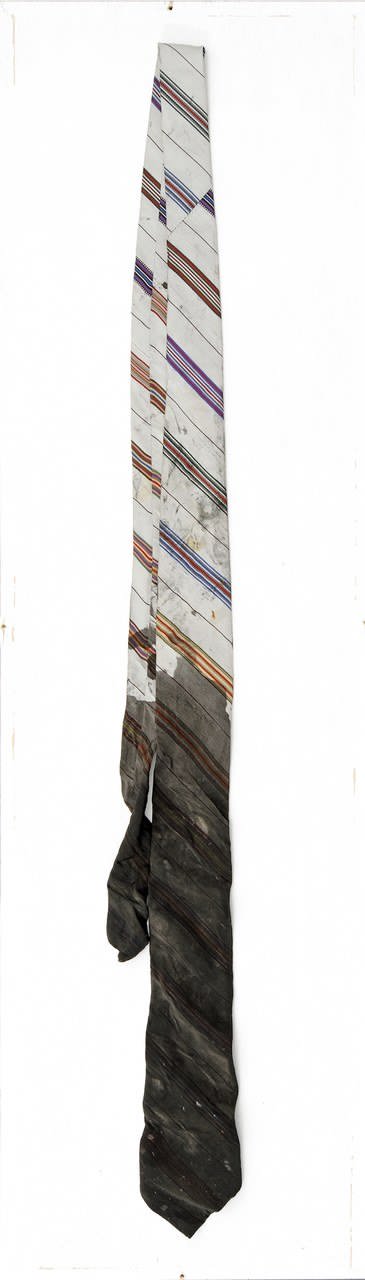
Somewhat overlooked in the art world’s urge to reenact, the collection of the Museum Wiesbaden houses a long white box containing a stained necktie sealed behind glass, which appears to stem from this historical event—a highly remarkable artifact, since virtually nothing was kept from the festival.[31] Unlike Marina Abramović’s artifact assemblage, which differs from objects used in the original Rhythm 0 performance (and which in its material aspect might be deemed "inauthentic"), Paik’s necktie carries an authentic link to its original use. Once wrapped around the artist’s neck and probably still carrying minimal parts of his body’s physical composition, in its current, patinated shape resulting from a dry, aged mixture of dirt, ink and tomato juice and uncomfortably connoting associations with other bodily fluids, the necktie is, in fact, quite literally an authentic bearer of Paik’s trace: a potent combination of presence and agency. Such relics, akin to parts of a deceased person’s body or belongings, are revered objects imbued with memory and imagination.
But here, and precisely for this reason, the necktie is enshrined in a protective case, ensuring its physical—rather than metaphysical—preservation. In striking contrast to the vibrant activity of Zen for Head, which has begun to function as an event-score in its own right, the necktie appears as if glimpsed from a distant past—like a strange voyager on a mission to deliver an encoded, yet somewhat illegible, message to extraterrestrials. Deprived of its original context and actuality, Paik’s necktie feels remote and detached, and the memory of the event from fifty years ago lingers as a wistful echo. This sentiment led us to ponder how the value of repeatedly present replacement artifacts might relativize the value of the "real thing."
Indeed, to be effective, relics—and particularly, in this essay, performance artifacts—do not need to attest to their material identity or authenticity in relation to the event that generated them. Just as the Catholic Church sanctioned the authentication of relics based on their "Zugehörigkeit" (German: belonging) to the originating event and their "Zulässigkeit" (German: admissibility) (not all venerated relics needed to be "authenticum"—to stem from the saint’s body—as long as they fulfilled their "work"), performance artifacts seem to be admitted to the work—or be "authenticated"—during the artwork’s life, regardless of the material evidence they carry.[32] Beyond axiological considerations and regardless of the "authenticity" of its objects, performance continually returns to the logic of the object.
5. Beyond the Object Principle?
"Love objects, respect objects," pleads American artist Claes Oldenburg, referring to the creative act of selecting and caring for what remains after a performance.[33] Oldenburg speaks of residual objects which are created during repeated performances. These "acted" or "domesticated" objects, as Patricia Brignone has described them, carry memories and histories that may continue to unfold into the future.[34] However, performance does not need to reside in objects alone; in fact, it rarely does. In the following discussion and expanding on the categories of objects outlined by Manzella and Watkins, we will focus on documentation and ephemera as part of the broader "material culture" of performance artwork.
Mike Kelley’s The Parasite Lily (1985) – a rich compilation of documents, historical photographs, instructions, notes and other elements prominently featured in The Ritual of Rented Island, an exhibition at the Whitney Museum of American Art (October 31, 2013-February 2, 2014) – serves as an excellent example.[35] The exhibition, based on a mélange of objects, documents, images and film documentation, highlighted a radical period of 1970s performance art in downtown Manhattan, dubbed "rented island" by filmmaker Jack Smith. In this period, artists from diverse backgrounds, including Kelley, created performances in lofts, storefronts and alternative spaces to address contemporary media, commercial culture and high art.
Kelley’s artistic project spanned painting, drawing, sculpture, film, performance and installation dismantling distinctions between high and low art. Although preferring "the frenetic anxiety of live performance," and entirely refusing filmic documentation for his early pieces (reflecting the belief that performance has to live in the moment so characteristic of the genre’s early years) as Tony Oursler recalls,[36] in this exhibition space, and as with Abramović’s Rhythm 0, the initial performance-event was absent, and yet The Parasite Lily was eminently present. The work presented a complex, multilayered structure of rehearsal documentation, film, photographs, facsimiles, slides and reproductions. This presence was connected with, although arguably not exclusively, the photography offered for inspection, linked with the argument posited by Auslander and Amelia Jones, who have claimed, each in their distinct ways, that photographic documentation is a space in which performance can be experienced.[37]
In Kelley’s The Parasite Lily, in a sort of genealogical interdependence, and attesting to the impossibility of overlooking this artwork’s persuasive material presence, facsimiles of documents built on other documents, either lost or still present, which in turn were built on other documents, at times even acquiring the status of individual artworks themselves. Beyond the principle of a discrete object, the artwork’s material "stratigraphy" seems here to never cease to expand, continually depositing new layers on the already accumulated material "sediment." Whether authentically linked with the performance-event or with the artist’s hand in the circulation of his work or added during the artwork’s lifespan by others (photographers, curators, conservators and the artist’s estate), this stratigraphy attests to the many subjectivities and choices made by individuals and institutions. One can only imagine how new interpretations, technologies and cultures of conservation and activation contribute to its ever-expanding, indeed pervasive, material presence.
6. Performance as Musealium
A more recent understanding of the relationship of performance to objects beyond documentation, artifacts and ephemera is that the performance as an event can be a musealium, something collectable and, in that sense, an object itself. Rie Hovmann Rasmussen identifies duration and repetition as key characteristics of performance that serve "to integrate performance into the [museum’s] core program."[38] Duration allows a performance to be available to viewers in the same manner as any other musealium. Abramović’s The Artist is Present (2010) is an example. As part of the performance, Abramović sat in a chair in the atrium of the Museum of Modern Art New York each day during the hours the museum was open for the entire duration of the exhibition, two and a half months. Abramović situated herself before the museum opened and left only after all visitors had departed, making it seem as if she was always there, an object with a continuous presence. Ernesto Pujol’s Nine to Five (2015) worked similarly, but in a public art context rather than a museum.
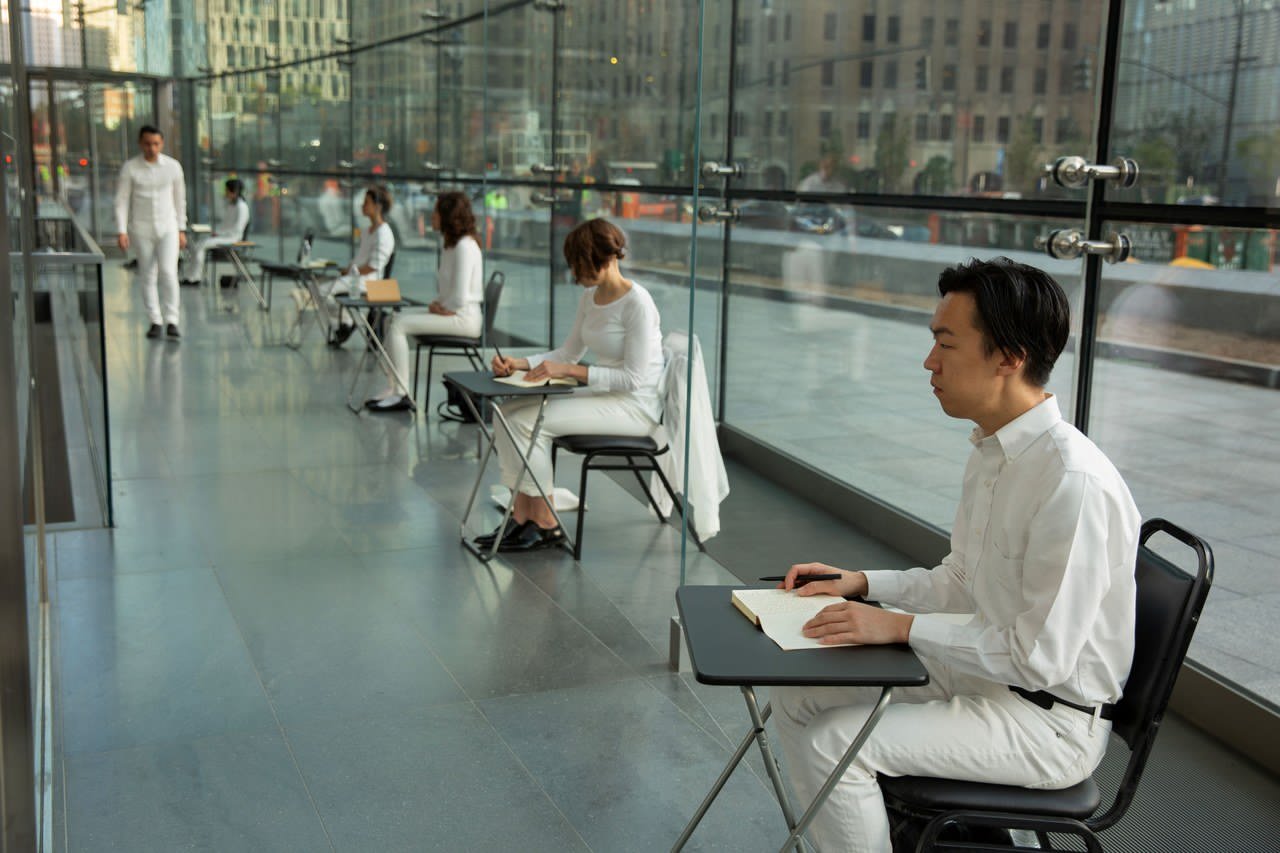
Miming the workday routine of the people around them, the performers were continuously present during business hours, as described in the press release for the work:
Eleven performers dressed in white will arrive by public transportation each day, silently moving to their positions adjacent the glass wall at the east side of the Brookfield Place Pavilion. Sitting formally between the glass partitions of the window, that mirror the quintessential corporate office workspace, each performer will write silently throughout the day about the people they see, creating a literature of pedestrian life in the city.[39]
Artist Tino Sehgal states directly that this effect of object-like continuous presence is what he wishes to achieve: "my work operates in the temporality of the visual-art exhibition. It’s always there, like any other artwork. You can walk in, you’re included. My work doesn’t start and finish."[40] 11 Rooms (2011) at the Manchester Art Gallery, co-curated by Klaus Biesenbach and Hans Ulrich Obrist, was a group show based around the same concept. The exhibition space was divided into eleven modestly sized rooms, each containing a performance. Spectators moved from room to room, witnessing a performance at each stop. Biesenbach and Obrist conceived the show on the model of a sculpture gallery featuring "living sculptures." Speaking of 14 Rooms, a later iteration of the same exhibition at Art Basel in 2014, Obrist said, "It is time-based art . . .. It has to stay in duration. 14 Rooms is a classical sculpture gallery when the works are there during opening hours from 11am to 7pm, but when the last visitors leave and the museum closes its doors, all the sculptures go home, too."[41]
The objectification of performance achieved through extended duration allows performance to be present in the museum and available to its patrons in a manner like paintings and sculptures. This represents a reversal in the relationship between duration and the art object as understood during the era of conceptual art. Then, the idea was to make objects more performance-like—contingent and ephemeral—through the emphasis on process found in both Serra’s lead splashes and de Saint Phalle’s gunshot paintings. Now, the idea is to make performances more object-like by emphasizing duration and repetition.
7. Objectification through Repetition
The continued presence and availability of a performance to the viewer makes it object-like. Some performances achieve continued presence through repetition. In Sehgal’s Ann Lee (2011), which premiered at 11 Rooms, an adolescent girl playing the titular character, a minor manga figure, introduces herself to the audience as an entity unfamiliar with human ways and asks them questions.[42] For this work to be continuously available, the scenario must be repeated throughout the time the exhibition is open to the public. Gerard & Kelley’s Timelining (2014) "features a series of paired performers involved in close relationships—romantic, familial, or otherwise. Moving through space in a circular pattern, a couple takes turns reciting snippets of their personal histories from the present moment backward."[43] In this case, the performance is triggered by the entrance of a spectator into the space and is thus continually available without being continuous.
In other cases, it is difficult to distinguish continuity from repetition. In Allora and Calzadilla’s Revolving Door (2011), also shown at 11 Rooms, a group of dancers arranged in a line that extends to the walls of the room on all sides replicates the motion of a revolving door so that visitors must coordinate their movements with those of the performers to enter the space. It is possible to see the dancers either as repeating a series of motions over and over or as engaged in one continuous action.
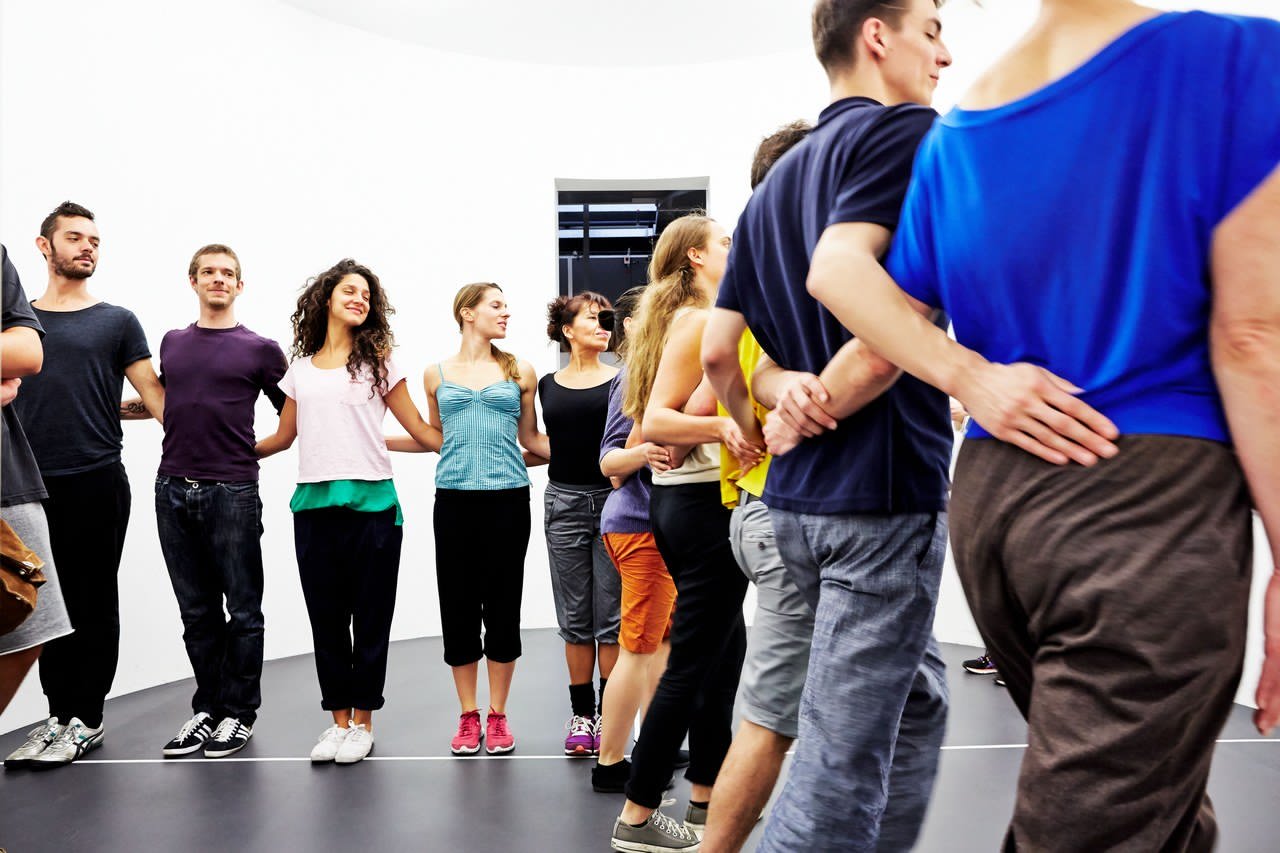
Beyond the use of repetition as a structural feature, the repetition of performances as transportable works defines the current economy of performance art and its institutionalization.
Performances that can be in some way repeated […] have affected the way performances are viewed within art institutions. Here artists are often encouraged to perform their own work on several occasions […] [In] these performances […] the same work is presented several times for different audiences and in a different institutional setting […].[44]
Gerard & Kelley’s Timelining was first performed at The Kitchen, New York City, in 2014. It was acquired by the Guggenheim Museum in New York and performed there in 2015. On loan from the Guggenheim, it was performed in Paris at the Festival D’Automne in 2017. Each of these venues is a different kind of institution: The Kitchen is a venerable alternative space founded as an artist collective in 1971; the Guggenheim is, of course, one of the most prominent of major museums, while the Festival D’Automne, founded in 1972, is a large-scale, multidisciplinary art event that is international in scope. Timelining is but one example of a performance that is designed to be presented multiple times in varying contexts. As is typical for such performance art, its scenario can be enacted anywhere with local participants. This is equally true for Revolving Door, where the main change needed to adapt the work to local conditions is the number of dancers used since their line must be long enough to block access to the performance space. This portability means that performances can be deployed like other musealia—they can be collected and lent by one institution to another, for instance. It enables performance art to find a place in the flows of an international art world in which works travel from gallery to museum, from biennial to art fair. This is as true of the performing objects that now make up the various table assemblages that are the ongoing versions of Abramović’s Rhythm 0 as it is of live performances.
8. In Conclusion: A Persistent Return to and through the Object
As we have shown here, the relationship between performance objects and the event whose memory and history they sustain is highly variable. In Abramović’s Rhythm 0, the relationship is functional rather than archival. The continued life of the performance resides not in objects that were part of the original event but in similar objects of the same kind that both evoke the original objects and allude to the possibility of a new performance of Rhythm 0 employing them. The value of these objects in maintaining the life of the performance does not depend on their authenticity. The preservation of Paik’s necktie as a relic, so reminiscent of Kaprow’s postulation of an "enduring object . . . in a locked case," enables it to serve as an historical artifact that indexes Paik’s performance. Arguably, however, it also deprives it of the ability to sustain his performance as a living thing. The nature of this continued life is illustrated by Kelley’s The Parasite Lily, which continues to develop and change through the extensions and reconfigurations of its artifacts, documentation and ephemera. The idea that performances’ continued life is as objects is further actualized in current practices in which performances aspire to object status through duration and repetition. In these instances, there is no original event to which subsequent iterations could refer, no sense in which the first iteration of the performance is the one of which all subsequent iterations are reperformances. As is the case for Serra’s lead sculptures, each iteration is a novel object struck from an existing template.
Displays have the power to fossilize events in the memory of those who experience them. They construct the work’s identity. Discussing the co-determining relationship between the ephemerality of the artwork and the materiality of its archive, Jonah Westerman describes performance’s multifold dimensions—built upon, among other things, the dialectics of ephemerality and the archive and reality and representation—as a field of tension between "seemingly opposed, yet intrinsically related concerns."[45] Negotiating these tensions, each work not only "positions its audiences and articulates its social, political and spatial situation"[46] in its own way, but also is no doubt materially constitutive. In the longer durée of such work, in the temporarily extended present, the event and the archive are co-determining.
Whether examined through the lens of its material histories or exhibition dispositifs, and independently from the degree performances resist musealization or institutionalization, performance art cannot be conceived of or theorized apart from the object. An attempt to do so would strip a performance work of the larger context in which the action is one element. Apart from ontological considerations, the history of the institutionalization of performance points to a rich material life of performance art evident in and as relics, residues, props and archival detritus (and the above are just a few examples). Beyond the factuality of collections, exhibitions and archives, in which the performance’s physical presence is manifest in a stratigraphy of scripts, scores, documentation, film, photography and narratives—a substitute as it were for the momentary "disappearance of the act"—recent research reframes performance as an object of conservation, situating performance in a long tradition of intentional upkeep of things.[47]
Again and again, performance repeats and returns to and through the object. By its very nature, it not only explicates the intricacies of transient art forms but also underscores that there is no way around the old, good traditional "object."
Acknowledgment
We thank the editors of this volume and the anonymous reviewers and for their valuable assistance. The research for this paper was in part supported by the Swiss National Science Foundation within the project [https://performanceconservationmaterialityknowledge.com/] (2020-25, grant nr. 100016_189245) that initiated the collaboration between the authors and contributed valuable primary sources. Sincere thanks to the research group members Felipe Ribeiro, Andrej Mirčev, Emilie Magnin, Aga Wielocha and Josephine Ellis and for their insightful contributions to thinking with and through the material culture of performance.
1 A. Kaprow, Assemblages, Environments and Happenings, New York, H.N. Abrams, 1966, p. 168.
2 For example, Catherine Wood argues that the methods of traditional art history are not adequate to discussing performance. Whereas those methods assume stable objects of inquiry, performance "rests upon a succession of disappearing acts" (C. Wood, Performance in Contemporary Art, London, Tate Publishing, 2018, p. 25).
3 R. Goldberg, Performance Art from Futurism to the Present, 3rd ed., London, Thames & Hudson, 2011, p. 152.
4 Confirming this view, albeit from a slightly different angle, a significant portion of performance theory and its afterlife has evolved in response to Peggy Phelan’s assertion of performance’s essential ephemerality, linked with its radical autonomy from the capital-driven mechanisms of the art system. P. Phelan, Unmarked: The Politics of Performance, London, Routledge, 1993, p. 146.
5 With a noted difference in the juridical mechanisms of performance art’s materialization in collection, which others have described in detail. See, for instance, S. Sykora, ‘Copyright Implications of the Preservation of Performance Art’, in Performance: The Ethics and the Politics of Conservation and Care, vol. II, H.B. Hölling, J.P. Feldman, E. Magnin (eds.), London and New York, Routledge, 2024, pp. 199-223.
6 L.R. Lippard, Six Years: The Dematerialization of the Art Object from 1966 to 1972, Berkeley, University of California Press, 2001.
7 J. Weiss, ‘Due Process: Richard Serra’s Early Splash/Cast Works’, Art Forum, 54, 3 (November 2015), <https://www.artforum.com/features/due-process-richard-serras-early-splash-cast-works-226187/> [accessed 12 November 2024].
8 The only existing lead splash, Gutter Corner Splash: Night Shift (1995), in the permanent collection of the San Francisco Museum of Modern Art, is a recreation by Serra of a work from 1969.
9 A. Blum, ‘A Serra Sculpture Emerges from Its Tomb’, New York Times, November 29, 2003, <https://www.nytimes.com/2003/11/23/arts/art-a-serra-sculpture-emerges-from-its-tomb.html> [accessed 12 November 2024].
10 See, for example, C. Lambert-Beatty, ‘Against Performance Art’, Artforum 48, n. 9 (2010), <https://www.artforum.com/features/against-performance-art-194279/> [accessed 16 November 2024] and A. Dozier, ‘The Legacy of Marina Abramović’s “The Artist is Present” Lives On with New Generations of Artists’, Artsy.net, 17 March 2022, <https://www.artsy.net/article/artsy-editorial-legacy-marina-Abramovićs-the-artist-present-lives-new-generations-artists> [accessed 16 November 2024].
11 ICOM, Key Concepts of Museology, ed. A. Desvallées, F. Mairesse, trans. S. Nash, Paris, Armand Colin, 2010, p. 50.
12 Among the most significant recent research projects with extensive resources available on their websites are Collecting the Performative with The Live List (Tate, Van Abbemuseum, Maastricht University, 2012–14); Documentation and Conservation of Performance (Tate, 2016– 21); Reshaping the Collectible: When Artworks Live in a Museum (2018–21), Collecting the Ephemeral: Prerequisites and Possibilities for Making Performance Art Last (Lucerne University of the Arts 2019-23), Precarious Movements: Choreography and the Museums (University of New South Wales 2021-2024) and Performance: Conservation, Materiality, Knowledge (Bern University of the Arts, 2020-25). See also H.B. Hölling, J. Pelta Feldman, E. Magnin (eds.), Performance: The Ethics and the Politics of Conservation and Care, vol. 1 & 2, London and New York, Routledge, 2023 & 2025, for the most recent compilations of critical essays addressing the questions of collecting, displaying and preserving performance in a global context.
13 C. Manzella, A. Watkins, ‘Performance Anxiety: Performance Art in Twenty-First Century Catalogs and Archives’, Art Documentation 30, 1 (Spring 2011), pp. 28-32.
14 Abramović describes this series as "A hammer. A saw. A feather. A fork. A bottle of perfume. A bowler hat. An ax. A rose. A bell. Scissors. Needles. A pen. Honey. A lamb bone. A carving knife. A mirror. A newspaper. A shawl. Pins. Lipstick. Sugar. A Polaroid camera. Various other things. And a pistol, and one bullet lying next to it" (M. Abramović, with J. Kaplan, Walk Through the Walls: A Memoir, New York, Crown Archetype, 2016, eBook, n.p).
15 Ibidem, n.p.
16 P. Phelan, ‘Marina Abramović: Witnessing Shadows’, Theatre Journal, 56, 4 (2004), p. 572, https://doi.org/10.1353/tj.2004.0178.
17 K. Hessel, ‘Marina Abramović’s Shocking Rhythm 0 Performance Shows Why We Still Cannot Trust People in Power’, The Guardian, September 25, 2023, <https://www.theguardian.com/artanddesign/2023/sep/25/marina-Abramovićs-shocking-rhythm-0-performance-shows-why-we-still-cannot-trust-people-in-power> [accessed 30 May 2024].
18 This moment also marks the performance’s premature ending according to one of the accounts, see L. Shalson, Performing Endurance: Art and Politics since 1960, Cambridge, Cambridge University Press, 2018, p. 75; M. Abramović, H. Hölling, et al, interview within SNSF Performance: Conservation, Materiality, Knowledge research project, June 9, 2021.
19 M. Abramović, with J. Kaplan, Walk Through the Walls, eBook, n.p. M. Abramović, A. Jones, ‘The Live Artist as Archeologist’ in A. Jones, A. Heathfield (eds.) Perform, Repeat, Record: Live Art in History, Bristol, Chicago, Intellect, 2012, pp. 543-66. Note that the initial concept for Seven Easy Pieces included Rhythm 0 as part of the exhibition, but it was rejected by the museum for security reasons.
20 Herbstreit analyses the table present at MoMA. M. Herbstreit, Aktionsrelikte: Ausgestellte Authentizität bei Chris Burden und Marina Abramović, München, Edition Mentzel, 2019, p. 273; M. Abramović, et al., interview.
21 D. Zuber, ‘Tool for Transcendence: The Transitory Object’, in Marina Abramović, Exhibition Catalog, London, Royal Academy Publications, p. 59.
22 D.W. Winnicott, Playing and Reality, London and New York: Routledge, 1989, pp. 1-25; J. Otero Pailos, ‘Experimental Preservation’, September 2016, <https://placesjournal.org/article/experimental-preservation/> [accessed 16 November 2024].
23 Ibidem. See also J. Otero-Pailos, H. Hölling, ‘Materials, Objects, Transitions: Jorge Otero-Pailos in Conversation with Hanna B. Hölling’, in H.B. Hölling, F. Bewer, K. Ammann (eds.), The Explicit Material: Inquiries on the Intersection of Curatorial and Conservation Cultures, Leiden, Brill, pp. 26-63.
24 A. Heathfield, ‘The Cult and the Line in Time’, in Marina Abramović, Exhibition Catalog, London, Royal Academy Publications, p. 33.
25 Ibidem.
26 H. Blau, Reality Principles: From the Absurd to the Virtual, Ann Arbor, University of Michigan Press, 2011, p. 114.
27 See, for instance, the video recording available in the archive of the Fundazione Bonotto.
28 B. Winther-Tamaki, ‘Remediated Ink: The Debt of Modern and Contemporary Asian Ink Aesthetics to Non-Ink Media,” Getty Research Journal, 10, 2018, pp. 133-34.
29 For the notions of allo- and autographic works, see N. Goodman, Languages of Art: An Approach to a Theory of Symbols, Indianapolis, IN: Hackett, 1976, p. 112.
30 The origins of Paik’s interpretation of Young’s score date back to Karlheinz Stockhausen’s Originale in 1961 in Cologne, where Paik swapped his work Simple with the interpretation of Young’s score. K. Wettengl, ‘Karlheinz Stockhausen’s Originale’, in R. Frieling (ed.) I Expose the Music: Nam June Paik, Spector Books, 2023, p. 27. Notably, the drawing depicted on page 22 does not reference Zen for Head but is instead titled Untitled (Krawattenzeichnung II), 1961.
31 The drawing resulting from the performance is also part of the collection, but it was unavailable for research during the writing of this essay.
32 Herbstreit refers to Peter Dinzenbacher’s discussion of church practices. M. Herbstreit, Aktionsrelikte, 89.
33 C. Oldenburg, ‘Residual Objects (1962)’, in Claes Oldenburg: An Anthology, New York, Guggenheim Museum, 1995, p. 143, <http://archive.org/stream/claesold00olde/claesold00olde_djvu.txt> [accessed 29 May 2024].
34 P. Brignone, ‘So Specific Objects’, in E. MANGION and M. De Brugerolle (eds.) Not to Play with Dead Things, Zurich, JRP|Ringier, 2009, p. 67.
35 Rituals of the Rented Island, exhibition at the Whitney Museum of American Art, 31 October 2013-2 February 2014. See also the eponymous book: J. Sanders, J. Hoberman, Rituals of Rented Island: Object Theater, Loft Performance, and the New Psychodrama: Manhattan, 1970–1980, New York, Whitney Museum of American Art, 2013.
36 T. Oursler, ‘Mike Kelley, <https://tonyoursler.com/mike-kelley> [accessed 29 May 2024]. Published in Artforum, 1, May 2012.
37 P. Auslander, ‘The Performativity of Performance Documentation’, PAJ: A Journal of Performance and Art, 28, 3 (September 2006), pp. 1-10, <https://doi.org/10.1162/pajj.2006.28.3.1>; A. Jones, ‘“Presence” in Absentia: Experiencing Performance as Documentation’, Art Journal, 56, 4 (1997), pp. 11-18.
38 R. H. Rasmussen, ‘Are You Not Entertained? Curating Performance within the Institution’, in D. Davida, et al (eds.) Curating Live Arts, New York, Berghahn Books, 2019, p. 352.
39 More Art, Press Release for Ernesto Pujol, 9-5, 1 October 2015, <http://moreart.org/wp-content/uploads/2015/07/Pujol_9-5_PR_October1.pdf> [accessed 16 November 2024].
40 T. Griffin, ‘Tino Sehgal: An Interview’, Artforum 43, n. 9 (2005), <https://www.artforum.com/features/tino-sehgal-an-interview-171417/> [accessed 16 November 2024].
41 ‘Hans Ulrich Obrist & Klaus Biesenbach on Co-Curating, Living Sculptures, and the Chance Encounter That Started It All’, Artsy Editorial, Artsy.net, 17 June 2014, <https://www.artsy.net/article/editorial-hans-ulrich-obrist-and-klaus-biesenbach-on> [accessed 16 November 2024].
42 In 1999, French artists Pierre Huyghe and Philippe Parreno bought a Japanese anime character named Ann Lee (or sometimes AnnLee or Annlee) from a catalog, gaining exclusive rights to use her image. For their joint project No Ghost Just a Shell, un film d’imaginaire, 1999–2002, they allowed around fifteen other artists to use the character in their own work. The project culminated in an exhibition at Kunsthalle Zurich in 2002 that brought together all these works, after which Huyghe and Parreno withdrew the character from circulation. Sehgal revived the character for his contribution to 11 Rooms.
43 ‘Gerard & Kelley Timelining’ Guggenheim Collection Online, New York, Guggenheim Museum <https://www.guggenheim.org/artwork/33472> [accessed 16 November 2024].
44 R. H. Rasmussen, ‘Are You Not Entertained? Curating Performance within the Institution’, in D. Davida, et al (eds.) Curating Live Arts, cit., p. 352.
45 J. Westerman, ‘The Dimensions of Performance’, Performance at Tate: Into the Space of Art <https://www.tate.org.uk/research/publications/performance-at-tate/dimensions-of-performance> [accessed 1 June 2024].
46 Ibidem.
47 R. Schneider, H.B. Hölling, ‘Not, Yet: When Our Art Is in Our Hands’, in Performance: The Ethics and the Politics of Conservation and Care, vol. I, H.B. Hölling, J.P. Feldman, E. Magnin (eds.), London and New York, Routledge, 2023, pp. 50–69, <https://doi.org/10.4324/9781003309987>.